Wooden house – Common room
INSTALLATION OF PANELS FOR EXTERNAL WALLS AND ROOF PANELS
The first step in installing the walls is nailing the corner abutment. The width of its sides corresponds to the thickness of the board. Chainsaws should have the same grooves (cutouts) side as plates. The tongue is then inserted into the grooves, forming a connection between the pillar and the plate. After nailing the pillar to the floor, with diagonally driven nails, height patches are attached to it 5 cm and the width is the same as that of the slab. These patches run along all the walls of the building. The boards are then placed on the battens and joined together by means of a tongue inserted into the board grooves. With the exact execution of individual steps, the pillars of the other end of the wall will hit exactly the corner of the floor. After the plates are embedded, they are joined together at the top with the same batten as at the bottom, which forms a wreath that strengthens the wall.
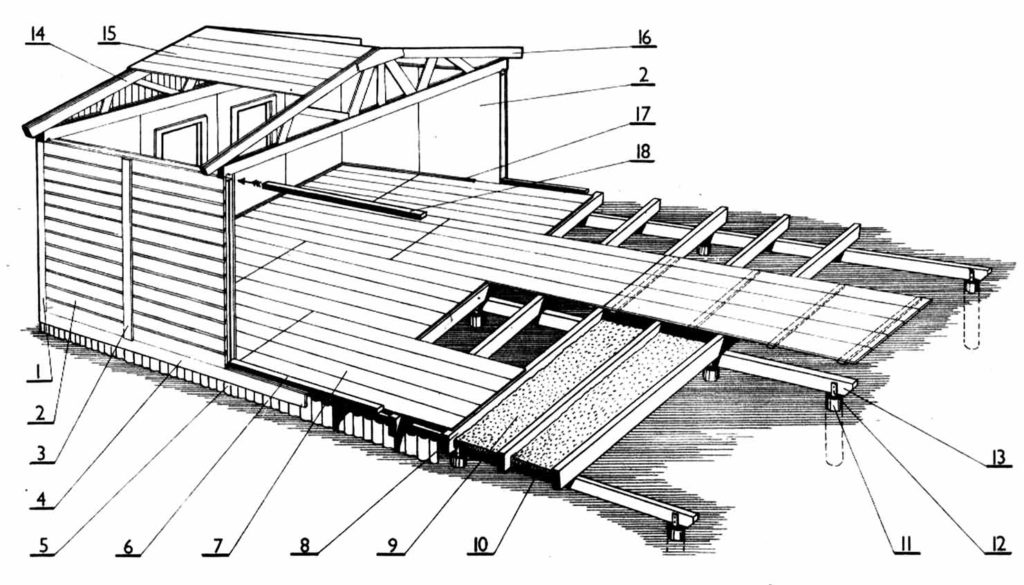
Individual stages of construction: 1 – corner pillar, 2 – wall plate, 3 -a strip covering the gap between the boards, 4 – lower cover strip, 5 – under-floor cover fixed on pins nailed to the stringer (foundations), 6 – bottom reinforcement patch, on which the plates are mounted, 7 – floor plates, 8 – floor joists, 9 – insulation, 10 – plate, 11 – pale, 12 – cut off, 13 – stringer (foundation), 14 – gable truss, 15 – plank roofing, 16 – intermediate truss, 17 – baseboard, 18 – a patch constituting a reinforcement wreath (cap).
After placing the panels forming the external walls, the trusses are mounted on them. Before that, however, the truss segments must be joined into a uniform whole. We are the first to install one of the gable trusses (extreme), by attaching it to the corner pillars with diagonally hammered nails.
So that the wind does not overturn the truss, we support it temporarily with a long board or a pole. Then we put on other trusses, whereby we lift them up from the ground level with the apex pointing downwards and then set them in the right position on the rim. The trusses should, in principle, be placed in the places where the panels are joined, fastening them from below to the wall rim with nails. So that the truss keeps its vertical position, temporarily connect it with a diagonally nailed batten to the adjacent truss. After embedding the last one, i.e.. the second gable truss, we attach the roof panels to the finished roof structure (previously prepared in the form of prefabricated elements) or we nail boards to it – according to the previously chosen solution. We board the gable trusses vertically or horizontally. Another solution for the closure of the peaks may also be adopted. The laying of the roofing material and the possible attachment of the eaves require no description, as the manner of carrying out these activities is generally known.
INSTALLATION OF PARTITION WALLS
The method of installing partition walls depends on the type of panels used, from which the walls are folded. The assortment of materials suitable for these boards is very varied. Partition walls are not exposed to moisture and weather conditions, such that the material requirements are practically limited to the condition, that it is strong enough and has sufficient sound insulation properties. If you use a sufficiently rigid and strong material, you do not even need to install frames for individual boards; such boards can be nailed directly on site to the wall frame made of battens or to square timber. Only in the place of the door openings a frame made of battens or square timber with dimensions appropriate to the thickness of the door frame is inserted.. It needs to be highlighted that, that during the production and assembly of elements and walls, it is necessary to care for their aesthetic appearance.
CEILING CEILING ASSEMBLY
Plates constituting elements of the ceiling soffit (fibreboards, chaff plates, plasterboards, boards) nailed directly to the chords of the lower trusses. Where they are small items, they are placed on a slab with a width equal to the spacing of trusses, which is then nailed to the underside of the trusses. Decorative boxes can be used instead of boards or boards, which will imitate a beam or cassette ceiling. In the joint between the ceiling and the wall, a strip covering the joint can possibly be placed.
HEATING
Experience shows, that the most appropriate heating device in the facilities in question is a fuel-fired stove, and a cooking appliance – gas stove. When choosing such a solution, it will not be necessary to build an expensive brick chimney on a special foundation, just install the cable (pipe) for the discharge of exhaust gases from an oil furnace. A metal pipe with a rectangular cross section is perfect for this purpose, available on the market. This conduit is encased above the roof in the shape of a traditional chimney and equipped with a roof that protects it against snow and rain penetration..
SANITARY INSTALLATIONS
The main problem when installing sanitary installations is obtaining the most convenient source of water. In most cases, the facilities in question will be built in areas with no public water supply, therefore, you will have to take into account the need to place a water tank inside the building, fed from the well. Because the trusses are of considerable strength, such a tank can be placed between two adjacent girders, placing it on the edges arranged transversely on the lower chords of the trusses. Water supply and drainage in such facilities can be very conveniently solved, because the building is built on stilts, therefore the water pipes can be routed under the floor. You should only remember about their thermal insulation in order to protect them against frost.
Given a description of the construction of the cottage – Of course, the day-room could not go into all the details of the performance. This is due first of all from here, that it provides guidance on a specific type of structure, and not a specific object with exact dimensions, on the basis of which it could be possible to provide precise data on materials and details of the technological process, Secondly, that with a limited volume of the article it is impossible to give extensive guidance, how to trim boards, nail the eaves, fix cement tiles, cover the wooden structure with varnish, etc.. Accepted, that readers have already gathered some experience in this regard, and in addition, that they can refer to the literature in the field of construction consultancy for non-professionals (themes, construction of a garage, holiday home, single-family house, etc.).
