Foldable garden seat – garden deck chair
Foldable garden seat
I don't think you need to convince anyone about it, that relaxation in the fresh air is pleasant and healthy, especially when warm, spring afternoon, among flowering trees and shrubs. For such a vacation, a simple one will be useful, colorful and foldable (actually unfolded) car seat, where you can sit back and read comfortably.
The structure of the seat is shown in the drawing.
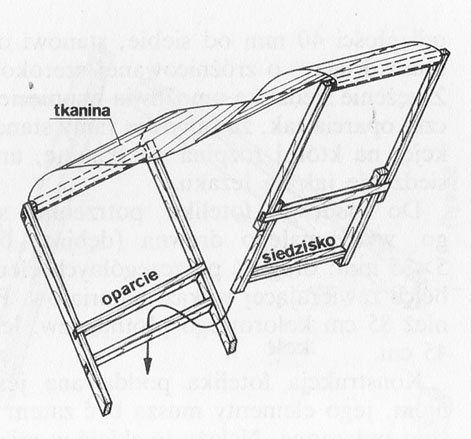
It consists of two separate wooden frames, one of which, equipped with two crossbars attached at a distance 40 mm apart, forms the backrest of the seat, while the second – of various widths – is a seat. The narrowing of the seat allows it to be inserted between the backrest crossbars, that both frames constitute a rigid structure, on which the fabric is opened, allowing you to sit comfortably on a deckchair.
To build the seat, you need hardwood slats, durable wood (oakwood, beech) with a section of 5×35 mm; the length of individual elements is given in the table containing the list of materials. You will also need it 85 cm of colored canvas, the so-called. deckchair, width 45 cm.
The structure of the seat is subjected to significant loads, its elements must therefore be very firmly and rigidly connected. They should be glued with a waterproof glue if possible, for example, Epidian, and strengthen the connections with wooden pegs with a diameter 10 mm.
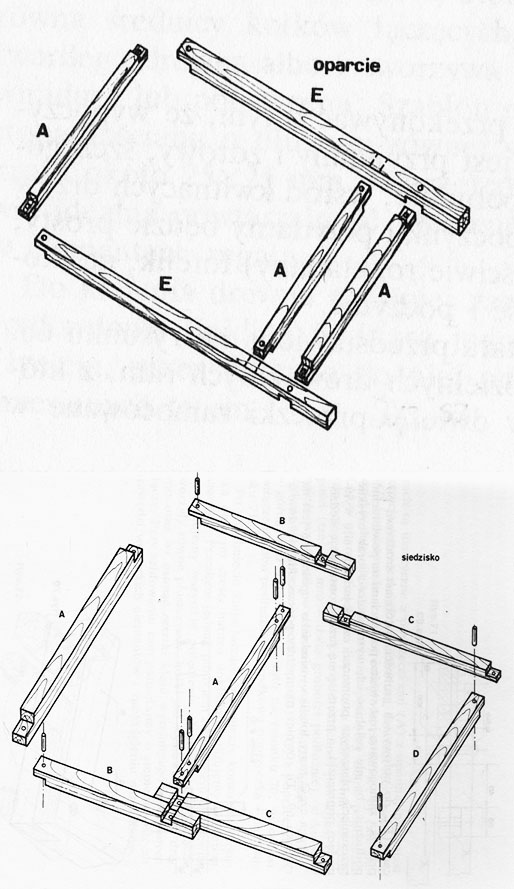
The figure shows the structure of the seat backrest, which consists of three identical elements (A) connecting longitudinal elements (E). All connections are made with an overlay; the distances between the crosspieces and the way of pinning the connectors are shown in the drawing. The lower crossbar is seated in sockets cut in the stringers (E), to half their thickness, while the middle crossbar is fixed longitudinally with its undercuts on the surface, in order not to weaken their strength and to obtain a shift of the plane of the crossbars, reducing the breaking force of the crossbar, and transmitted by the seat structure.
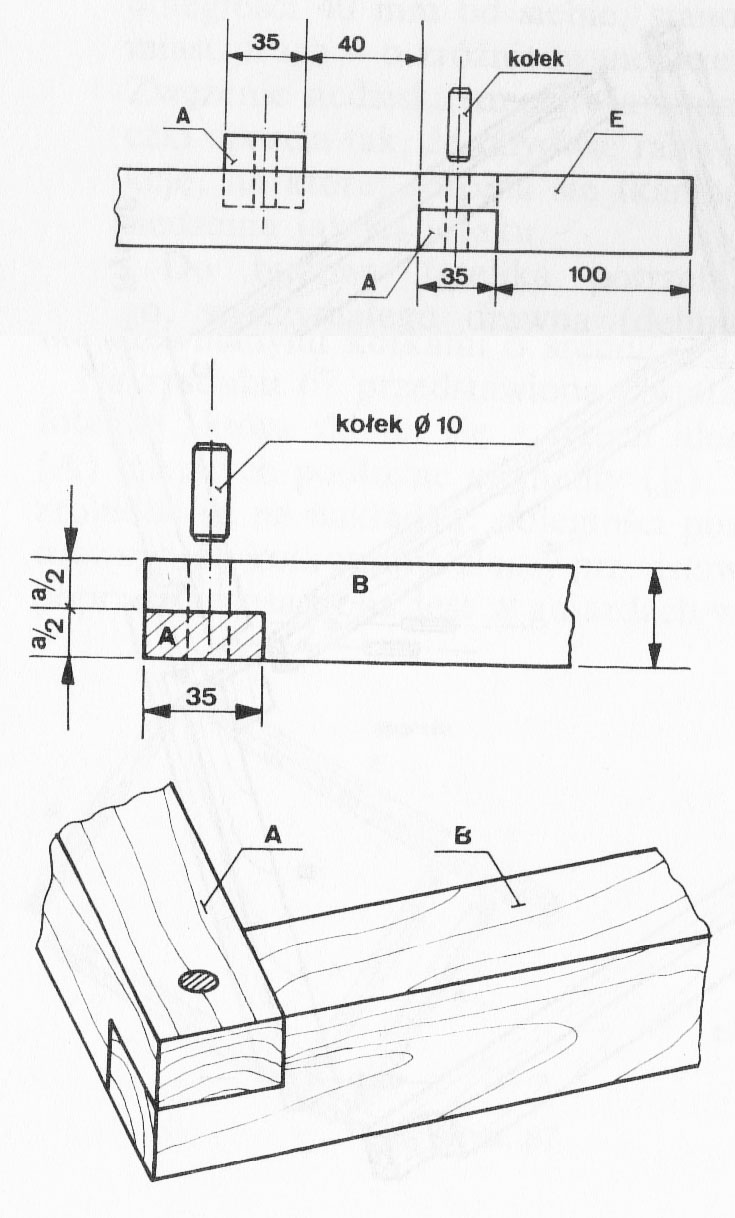
The second part of the seat frame - the seat - is shown in the picture. We also have three crossbars here, but two of them are identical to the crossbars (A) from the backrest, while the third crossbar (D) is shorter, because it connects stringers (C) mounted at such a distance from each other, so that the whole seat could be tucked tightly between the lower crossbars (A) based. The central crossbar of the seat has undercuts (to be connected to the pad with stringers) double length (i.e.. 70 mm – two thicknesses longitudinally), in which you should drill two holes for the connecting pins. The method of making a longitudinal connection (B) i (C) with a crossbar (A – upper and D) shown in the figure, while the combination of both longitudinally with the central crossbar – in the drawing.
After the glue connecting the elements of the seat structure is dry, both its parts are carefully sanded with sandpaper. Before that, however, we use a wood file to even out all the connections of the elements, that the joints form equal planes, the pins do not protrude above the wood and to remove any glue residues squeezed out of the glued joints. When sanding frames, remember to blunt the sharp edges of all elements and round the corners.
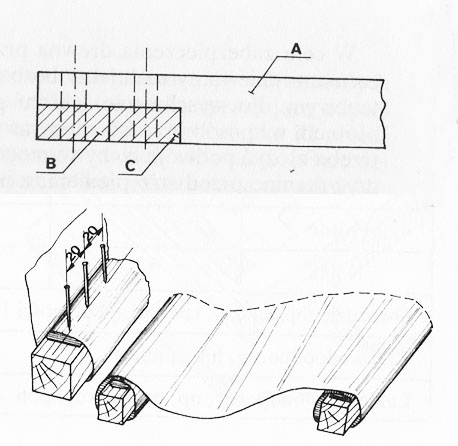
In order to protect the wood against moisture and contamination, both frames are painted with a colorless polyurethane varnish. After the varnish is dry, connect the car seat frames with the canvas as shown in the picture. The edge of the canvas must be folded twice, to strengthen the connection and prevent the fabric from fraying, and then nail the length with steel nails 15-20 mm – the so-called texas. These are upholstery nails with quite large heads, which should be deployed at 20 mm. After nailing the canvas, cover the heads of the nails by wrapping the fabric around the crossbar. We fasten the other edge of the canvas in the same way.
Preparing the seat for storage consists in removing the seat from between the backrest crossbars and folding both frames parallel to each other.
|
Element |
Number
items |
Dimensions in mm |
|
A |
5 | 35x35x520 |
|
B |
2 | 35x35x350 |
|
C |
2 | 35x35x300 |
|
D |
2 |
35x35x450 |
| E | 2 |
35x35x700 |
| Canvas | 1 |
450×850 |
| Pins | 14 |
Ø 10×35 |
| Upholstery nails, the so-called. texts, length 15-20 mm | ||
| Waterproof glue, e.g. epidian | ||
|
Waterproof varnish, e.g. colorless, polyurethane |
||
