Construction of walls and ceilings, part 4
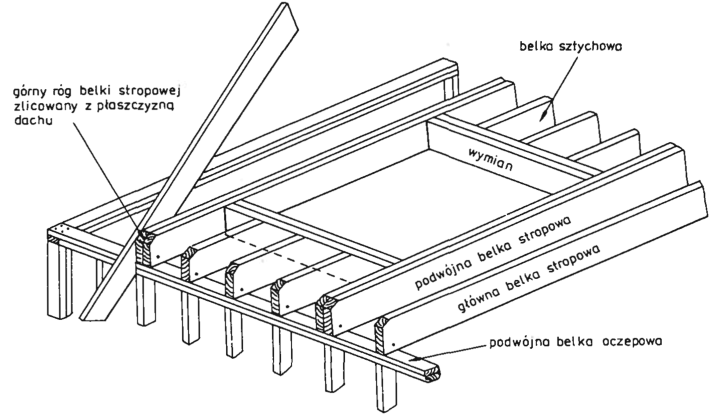 Nomenclature of floor beams at the floor opening.
Ceiling beams.
Usually they are made of logs with a cross-section 50 x 100 mm, 50 x 180 mm or 50 x 200 mm.
The largest spans of wooden beams in meters between the support centers for a total floor load of 3000 N/m2 (300 kG/m2).
 Spacing of floor beams (attic floor joists) usually it is equal to 40 cm, except for the structures around the mantelpieces. In the case of a large span of the ceiling, it is necessary to use binders.
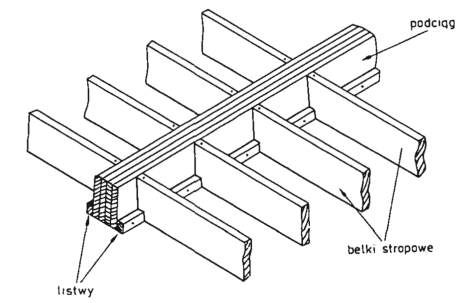 A binder lifting the floor beams at the midpoint.
maybe (exchange) ceiling around the chimney openings, stairs, just like floor joists, must be double.
Fig. 1 Different support of the floor beams on the binding beam.
Fig. 2 Supporting the floor beams on the binding beam in specially made sockets, the so-called. shoes made of a flat bar.
Fig. 3 Also a good way to connect the floor beams with the joist.

Ceiling corners
These are structural elements that allow for nailing in the corners of the ceiling lining (boards, chipboard etc.). The construction of this element is shown in the drawing.
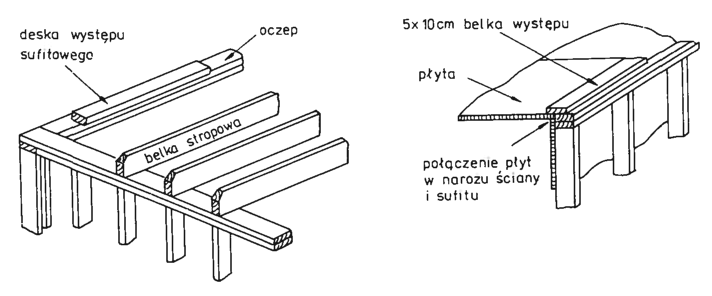 Ceiling finishing in the corner of the wall and ceiling.
Usually, cross-section logs are used for the corners 50 x 100 mm.
Construction of the sleeper joists on a brick or stone foundation.
 Construction of the sleeper joists on the concrete foundation.
How to construct a wooden scaffolding?

The following rules must be adhered to:
– we only use high-quality wood, preferably pine;
– vertical posts of the scaffolding (racks) should be positioned like this, to:
– the distance between the axes of the posts in a plane parallel to the wall was no more than 2,50 m,
– the distance between the axes of the posts in the plane perpendicular to the wall was no more than 1,50 m,
– the distance of the inner row of posts from the wall was no more than 35 cm.
For tall scaffolding stands, square timber with a cross-section of at least 120 x 120 mm. For low scaffolding (to the height 3,0 m) minimum cross-section logs can be used 50 x 100 mm:
– foundations – thick logs 50 mm and width at least 200 mm;
– braces – edged boards in thickness 25 mm and a width of not less than 120 mm;
– stringers – edged boards in thickness 38 mm, width at least 220 mm and with a length equal to two post spacing plus 50 cm;
– cross member – square timber with a cross-section 120 x 120 mm;
– platforms – edged boards with a thickness of at least 32 mm and width 180 mm;
– the length of the nails should be 2,5-3 times greater than the thickness of the nailed wooden element, however not less than 7,5 mm.
ATTENTION! Braces should be used (boards with a cross section of not less than 25 x 150 mm nailed at an angle of 45 ° to the structural elements) remembering that, that too many of them are, however, always safer than too few! If the scaffolding is over 2 m, use a safety rope or wood railing. Always use at least two deck boards (sidewalks) closely adjacent to each other.
