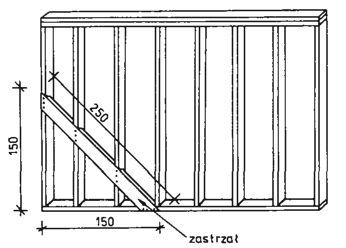
Construction of walls and ceilings, part 3
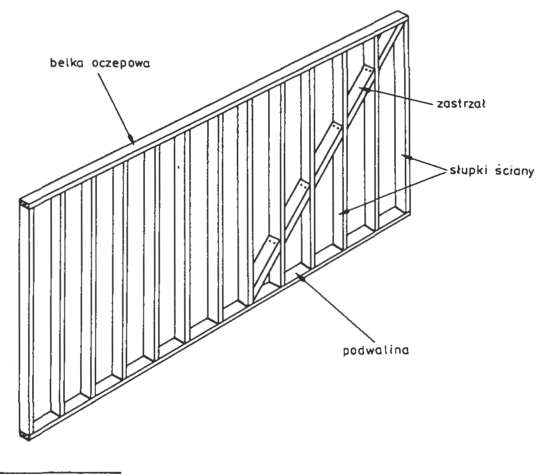 Embedding a diagonal brace into the wall.
Nailing the braces.
Nailing the struts may take place during the entire construction process. If the sub-floor is level and the wall frame is perfectly made, the struts can be nailed down before erecting the wall. This method is the easiest and saves us a lot of time. If diagonal formwork for walls is used or plywood is used, no braces are needed. The use of braces is an absolute necessity in the case of horizontal or vertical wall formwork.
STAGE SHOTS.
Cross-section logs are used 50 x 100 mm nailed at an angle of 45 ° to the vertical posts of the wall frame. This is the least effective way to achieve high wall stiffness. Such a strut prevents the implementation of wall insulation, and also in the placement of firewalls.
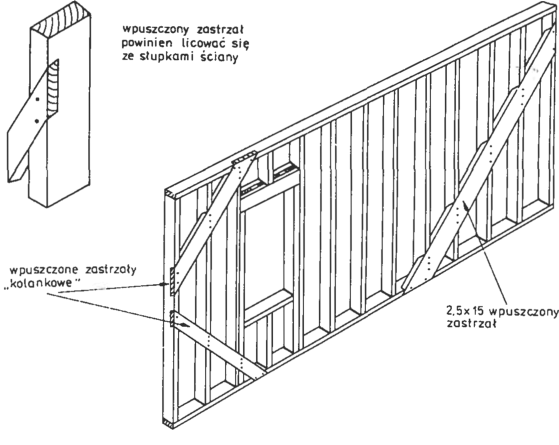 Angled corner struts of the walls – indented.
SHOT CONTINUOUS
The method of their implementation is shown in the figure. A board with a cross-section 25 x 100 mm is nailed at an angle of 45 ° to the wall studs, in which appropriate cuts are made to the thickness of the board.
Wall formwork
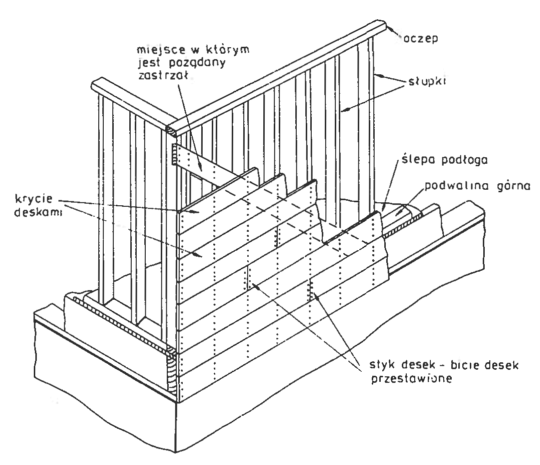 Horizontal formwork of the wall from the outside
CONTINUOUS FORMING
Horizontal and vertical wall formwork requires the use of braces. Planks should be beaten with an overlap to each wall column. Diagonal formwork does not require the use of braces.
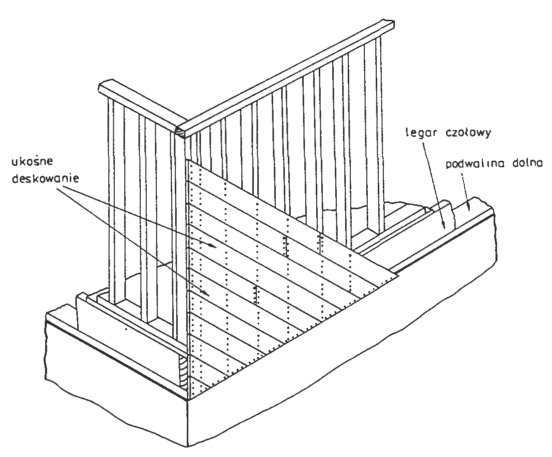 Diagonal wall formwork from the outside.
Plywood is the best material to cover a wall. As a result, covering with plywood gives the greatest stiffness of the wall.
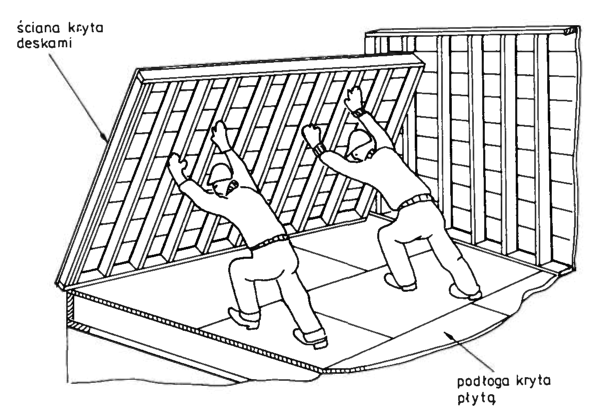 Placing a boarded wall on the sub-floor platform.
Dimensioning of wall braces.