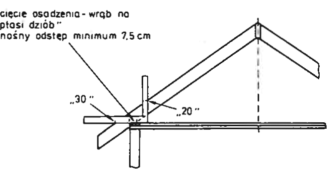
Construction of a gable roof, part 1
Gable roof construction.
The construction of the roof frame is one of the most difficult problems, with whom the carpenter meets. Use of a carpentry square (determinant) however, it reduces mathematical operations to a minimum and virtually anyone can master the technique of building a roof. The starting point for all related activities is a right triangle.

The length of the rafters is determined as shown in the drawing.
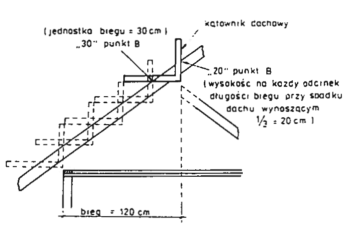
A gable roof with a gable wall
 This form of roof is very popular in Poland. It is good, simple solution, structurally easy to make.
 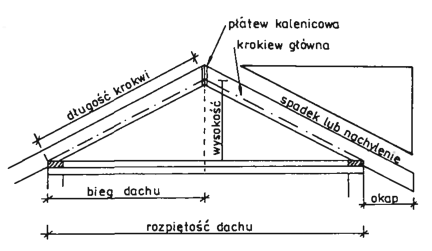 Before starting the description of the structure, it is worth familiarizing yourself with the terminology used in the construction of roofs:
– roof run (a), also called the base of the roof – is half the roof span;
– roof span (2 x a) – this is the horizontal distance, at the height of the rafter support, between the outer edges of the caps;
– roof height (h) – it is the distance between the roof ridge and the floor beam projected at right angles to the floor surface;
– roof slope (i) – it is the ratio of the roof height to the roof flight, that is, to the middle of the roof span. Roof pitch can be reported:
– in degrees of inclination of rafters in relation to the level, e.g.. 14°(tg α = h/a),
– as a fraction, e.g. 1/4 (i = h/a),
– as a ratio of integers, e.g. 0,25 (i =h/a),
– as a percentage, e.g. 25%, (i = h/a · 100%);
– the length of the rafters (I) – it is the length of the line, i.e. the distance between the outer edges of the wall and the centerline of the thickness of the roof ridge purlin. The total length of the rafters is equal to the length of the rafter line plus the end length of the eaves rafter minus half the thickness of the roof ridge purlin. The ridge purlin may be thick 25 mm (ridgepole) or 50 mm (ridge log);
– vertical cutting of the roof – it is a cut made at the upper end of the rafters and serves to connect it to the ridge purlin of the roof;
– cut of the presser foot – it is a cut made vertically at either end of the rafters;
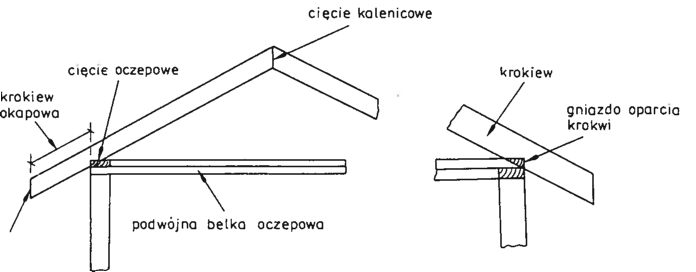
– cap cut (also called saddle) – it is part of the rafters cut after this, to ensure good adhesion of the rafters at the support point on the cap.