Construction of walls and ceilings, part 1
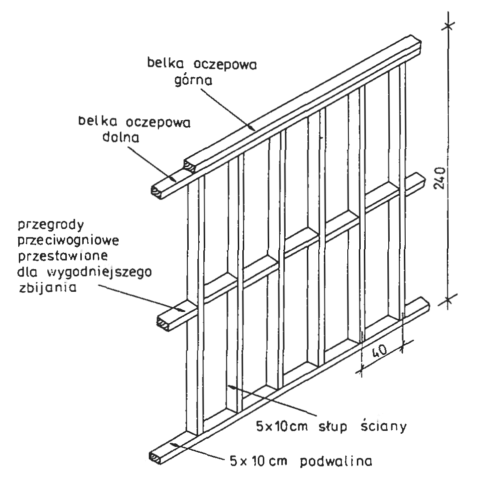 Frame, columnar wall.
Frame walls
Frame walls are made of logs with a cross-section 50 x 100 mm, i.e.. from vertical bars, two horizontal bottom logs (foundations) and two upper ones (top hatches) and logs being the horizontal partitions of the posts. Bale (stiffening compartments) are nailed after the wall is set up, building in partitions, placing all structural elements vertically and nailing the struts. Cap logs are overlapped, i.e.. the cap of one wall overlaps the gable cap of the other wall. In modern structures, the height of the wall is taken equal to 2,40 m, in which the vertical bars are spaced at 40-55 cm. Keep in mind when cutting out the posts, that their length, including the thickness of the top and bottom logs, should be equal 2,40 m, that is, the bars are in practice equal in length 2,20 m.
Stiffening logs.
They are horizontal logs with a cross section 50 x 100 mm nailed to vertical posts halfway up the wall. To make hammering the nails easier, it is recommended to nail them shifted against each other. These logs serve as wall stiffening elements, fulfilling the same role as the transoms in a traditional skeleton wall.
Determining the location of wall elements
These activities begin with arranging the elements of one corner and determining the position of the vertical wall posts.
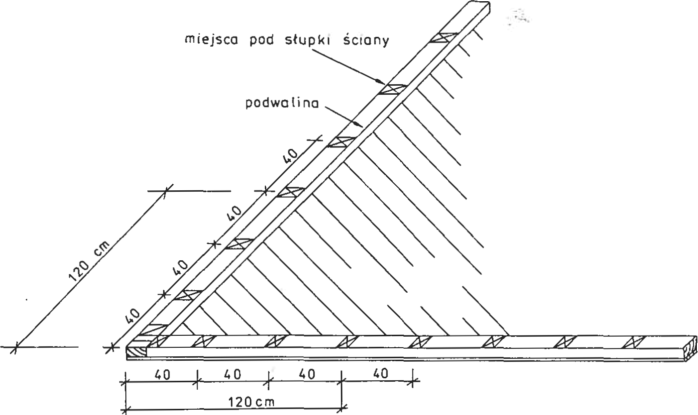 Arrangement of places under the wall frame posts on the foundation.
It is worth checking the position of the posts spaced apart by 120 cm. (bo 3 x 40 cm = 120 cm).
 Marking the positions of the posts in the wall with the use of a wall angle.
Additional posts are built in, when you need to make a hole in the wall (door, windows) or attach a partition, i.e.. partition wall.
The described activity marks the position of the wall columns exactly above the floor joists (floor logs are similarly positioned above the wall studs).
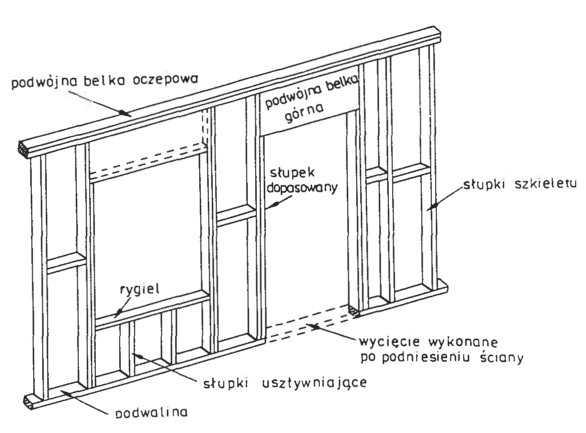 Nomenclature of wall frame construction elements.
