Blind floor
 Constructing the sub-floor from boards at right angles to the joists.
Blind floor.
It is the first floor layer to be laid on joists. The most commonly used material is pine and spruce boards, less often fir thick 25 mm with tongue and groove joint "own tongue."” or chipboard thickness 15 cm. The plates are only used then, when it is intended to apply to the entire surface of the carpet. The role of the "sub floor" made in this way is to join all the legends together and create an underlay, on which the walls of the house will then stand.
How to lay a sub-floor?
A better type of underlay is a sloped blind floor, because it will allow you to lay the right floor in any direction later. Strength considerations for choosing the type of formwork in a one-story cottage are irrelevant. The drawing shows how to start the formwork process.
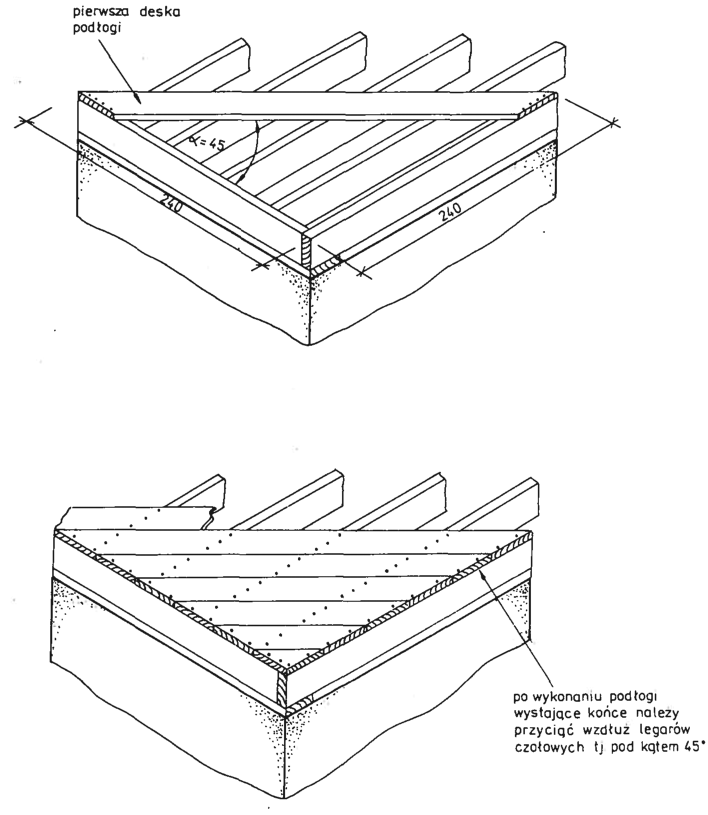 Constructing the sub-floor from boards placed diagonally in relation to the joists.
The ends of the boards protruding beyond the floor outline should be cut off after the formwork is finished.
How to make a sub-floor of chipboard or plywood?
The drawing shows how to make a chipboard or plywood floor.
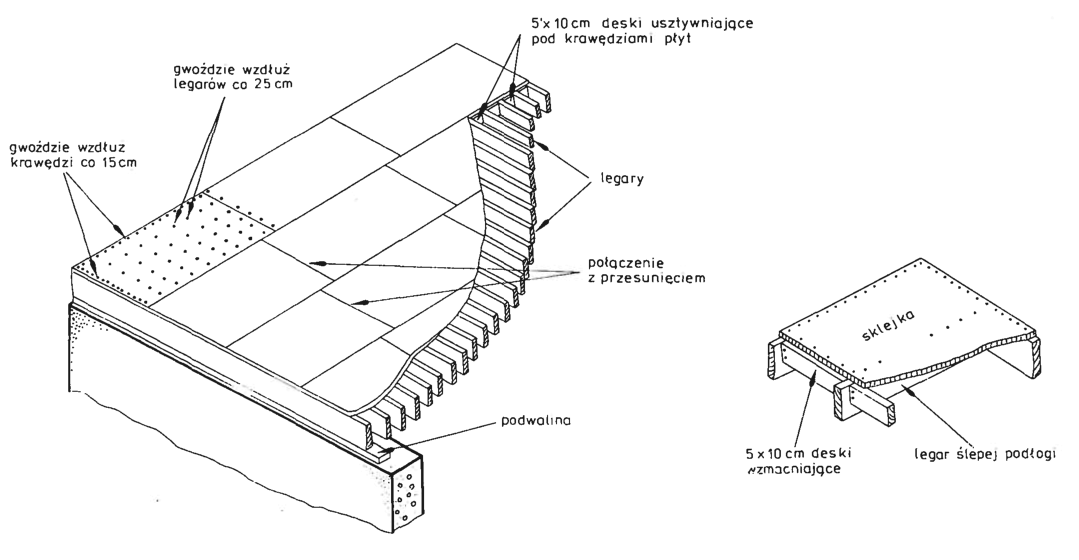 Making a sub-floor of chipboard or plywood.
It starts with nailing the corner plate. The next slab is shortened by the spacing between the joists (The 40 cm) and nails next to the first record. The next third record will be shortened by 80 cm and nailed to the joists, etc.. This method of nailing stiffens the floor.
The thickness of the chipboard or plywood depends on the spacing between the joists. For the spacing of the joists every 40 cm, chipboard and plywood are used in thickness 12,5 mm, though thickness is recommended 15 mm. Thick plywood 19 mm should be used with a joist spacing of 55-60 cm. To prevent the possibility of plywood boards and chipboard sliding in the corners and along the edges, reinforcing logs with a cross-section are used 50 x 100 mm nailed to the joists and boards at their joints.
ATTENTION! Additional reinforcement boards are not necessary for a grooved floor (the so-called. own pen). The entire floor should be nailed to the joists, the boards must not be joined except for the joists.
