Foundations
Foundations
Buildings should stand upright and not sink into the ground. This is achieved by building them on extended foundations, providing them with a stable base. Usually, continuous footings are used under walls, and footings for stupas or pillars. This enlarged base area of the building is usually sufficient, to prevent it from settling and thus the risk of cracks forming in the walls: gives it stability.
In buildings without a basement, a reliable slab foundation is often made. The weight of the building is distributed over the entire surface area of the slab foundation, thereby reducing the load on the ground. This makes it possible to use a compacted sand bed on the substrate. With this method, you can often, mostly, save your cost.
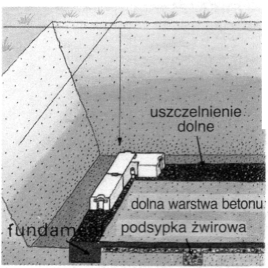 The foundations are ready and you can start bricklaying
House sewers
House drains connect the domestic sewage system with the street sewer. If they are to be placed under the basement floor, then they should be placed before concreting the strip footing or the foundation slab. For this purpose, according to the situational plan, grooves are dug in the excavation for the building. House drains should be positioned very carefully, because later it will be difficult to change their position, due to the fact that they are covered with a layer of concrete. We make them on a gravel or sand bed with a slope 1:50 towards the canal. The diameters of house drains and the necessary inspection openings are determined on the basis of the sewage system design. Close the open ends of the pipes with paper, to prevent debris or concrete from reaching them.
| Clarification of slope markings | |
| Decrease | means |
| 1:100 | 1 cm drop on 1 m of cable |
| 1:50 | 2 cm drop on 1 m of cable |
| 1:33 | 3 cm drop on 1 m of cable |
| 1:20 | 5 cm drop on 1 m of cable |
