Dig for foundations
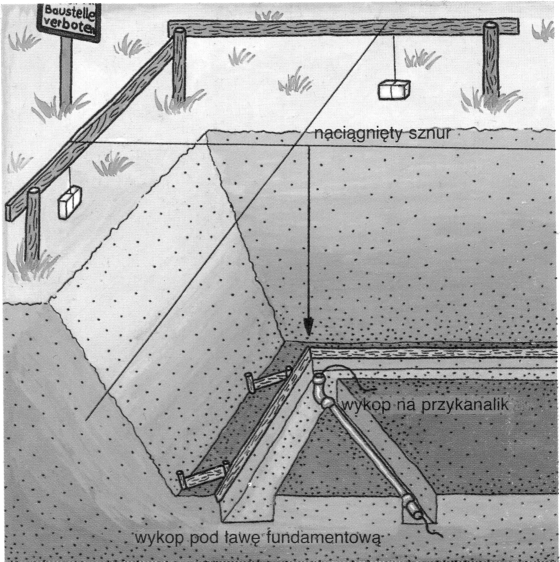 Dig for foundations – Marking out the excavations for the footing and the house drain.
One of the first questions, which advanced DIY enthusiasts often ask themselves, sounds: Can I do the job myself?, do I need tools or machines for this, or do I need to use someone else's help? These questions can be answered quite easily, when it comes to digging for a building. If someone would manually perform work involving the movement of several or several dozen cubic meters of earth, for example, when excavating for a single-family building with a complete basement, such saving would not make sense. The best solution in this case is the excavation for the building by a specialized company with a wheeled or tracked excavator.. If, on the other hand, small excavations need to be made, for example, for garage foundations or continuous footings, this can be completely done by hand with a shovel and shovel. The top layer of plant soil (humus) excavated from the excavation should be placed separately. Humus is a valuable material, which will later be needed to grow the garden. Some of the remaining excavated material will be needed later to backfill the excavation around the building, and the rest should possibly be taken away. Keep this in mind, in order to maintain sufficient space during the excavation for the building, allowing construction works to be carried out. Means, that in the excavation outside the outer basement walls, a free work belt of at least 50 cm is available. Outside the excavation of the building, the so-called. rope benches. Using these benches, you can stretch the strings along the designed external walls of the building, and their intersection points will be marked by the corresponding corners of the house. Then, leaving the bricklayer's plumb line at the crossing points, with an accuracy of one centimeter, the external dimensions of the foundations can be determined (at the same time the dimensions of the building). In case of difficulties, use the services of a surveyor. After the excavation for the building has been made and the cord benches have been made, the excavation for the footing and house drains is made. The location of house drains can be determined on the basis of the design of the plumbing and sewage system or the expected location of the plumbing risers in the bathroom and kitchen. The width and depth of the excavation for the footing is determined on the basis of the structure strength calculations or in the case of a project – according to him. They are dug like this, that they have perpendicular walls and the sharpest edges. Larger side holes in the ground are leveled with boarding. The bottom of the foundation must be horizontal and even. In the case of manual excavation of the strip footing, it is recommended to lay it out, on both sides, thick boards, which will facilitate the accurate execution of the works.
