Stairs
Stairs
 Nomenclature used in the construction of stairs:
1 – the cheeks of the stairs
2- stairs (footrest)
3- substation (riser)
4-handrails
5-tralki (bars)
6- tread width
7- riser height (degree)
8- the width of the stairs
9- the height of the stairs
10-railing height (handrail)
11 – balusters spacing
An important point in the design of stairs are geometric treatments based on the principles of a right triangle. The figure shows the nomenclature used in the construction of stairs. There are several distinctive dimensions, which you need to know before you start building the stairs:
by the height of the stairs (H) – it is the distance between the ground floor level and the first floor floor level;
about a flight of stairs – is the horizontal projection of the height of the stairs, i.e.. the length of the stairs measured horizontally;
on the cheeks of the stairs – these are side construction elements, on which the steps rest directly;
o stairs (footrest – S) – it is the width of the step;
o substation (riser – h) – it is the height of the step;
by the width of the stairs – this is the width measured along the outer edges of the cheeks.
ATTENTION! Accepted, that the sum of double the amount (2 x h) and width (S) the degree should be equal to the length of a normal adult stride, amounting to:
2h + S = 63 cm
The step height should be kept within the limits of 16,5 do 20,0 cm. Degrees higher than 20,0 cm are considered high. The width of the stairs in residential cottages should not be less than 70 cm.
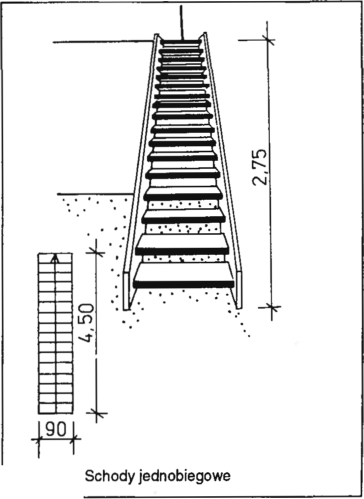
Good stairs are easier to walk!
When the shortest connection between two points is straight, then the stairs must also be the shortest connection between the two planes of the story. This is certainly or similarly how the concept is defined by stair designers. But this term for stairs for everyday use is too modest. We evaluate stairs from many points of view: first and foremost with their functionality, and then their aesthetics. In these premises, we then look for appropriate functional as well as aesthetic elements through the shape, form and type of material (wooden stairs). The versatile use of stairs in the construction industry requires taking into account the proper construction of the stairs, according to the conditions and needs. Building stairs must be subject to appropriate regulations, taking into account their bandwidth, lifting capacity, fire safety, the possibility of transporting furniture, home appliances, etc..
