Different types of stairs
There are basically four different types of stairs, and among them there are various possibilities for combining them:
o single-flight stairs. 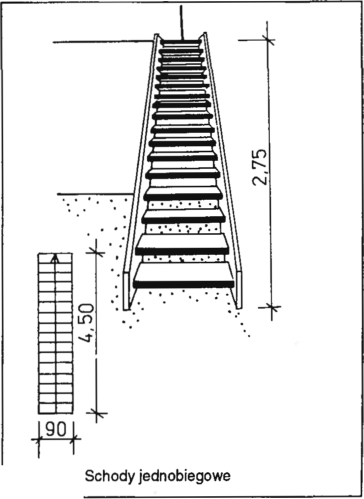
Simple to remove and the easiest to put up. Their disadvantage is the high demand for space along the entire length of the run;
o two-speed stairs (landing) 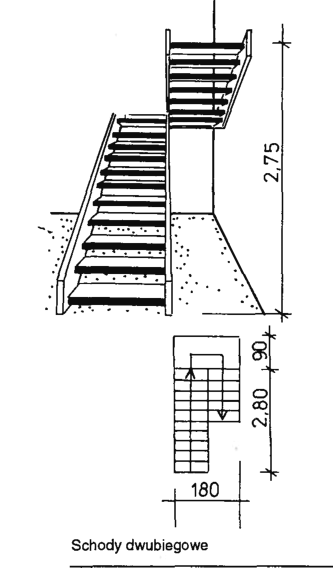
– can be placed particularly well in a building, as individual lengths may vary;
temporary broken stairs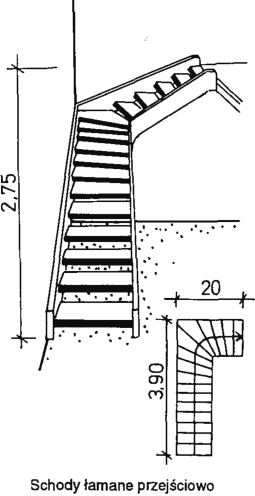
– are used in single-family houses. With this construction, you can make good use of the slope of the roof plane;
about a spiral staircase
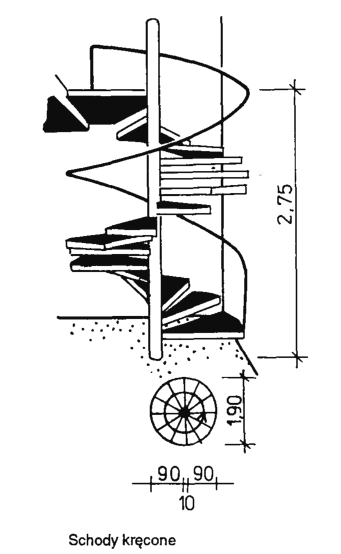 – if they are to be comfortable, they require more space and space to locate them.
When choosing this or that type of staircase, the size of the area intended for this purpose must be taken into account. The length of the stairs is determined by the distance between the stories, which they are to connect, and the so-called. rise proportion. The latter condition is commonly referred to as steepness or slope, which determines the comfort of overcoming them, so tiring or not.
The principle of ascending stairs is based on two measures: the height of the step and its width – depth (i.e.. the width of the climb), which should not be confused with the width of the stairs corresponding to the length of the steps. In the simplest form of stairs, i.e.. ladder, the depth of the step is not taken into account, but only the remoteness of the rungs. Similar rules are observed with multi-step stairs, where the depths of the steps are sometimes considerable with their height and climbing ability being insignificant. From this it follows, that, under certain specific conditions, we can differentiate the elements of stair climbing on individual sections of the same type of stairs by using different dimensions.
However, in order for the stairs to be comfortable, 15-degree sections should be designed. They can be in a 13-degree dimensions, but then they are steeper. Particularly favorable rises are obtained when the height of the steps is equal 17 cm and their depth 29 cm. The use of these dimensions creates comfortable conditions for climbing the height of the stairs.
Naturally, we must remember this, to avoid exceeding 19 cm of step height in the normal connection of two storeys (basements and free-standing stairs are excluded from this standard – off-road). With that in mind, what I mentioned above, the stairs should be marked with a place and space to be placed, then answer the question, what will be their form and height.
The form of single-flight stairs seems to be easy and simple. There is a certain monotony with the straight continuity of these stairs and they easily get boring, but they are of comparable value and serve a specific purpose.
