Wood-based materials
Wood-based materials
In addition to the lumber already discussed, made of solid wood, wood-based materials are produced (Lynx.), such as: veneers (forniry), plywood, furniture blockboards, chipboard and fibreboard, sandwich wood, and other types of improved woodwork.
The mentioned materials enable the economical and rational use of any wood waste. We will now discuss the method of manufacturing, properties and application of individual wood-based materials.
Veneers are very thin layers of wood of various dimensions obtained by rubbing, planing or flaking tree trunks with the help of special machines called peeling machines. Currently, veneers are most often produced by circumferential peeling or flat cutting. Veneers are used in carpentry to cover furniture surface, made of inferior types of wood or wood-based materials, and for the production of plywood. The thickness of the veneers can be from 0,3 do 3,5 mm, however, veneers of thickness from 0,6 do 1,0 mm.
Veneers are made of the best quality wood
– deciduous and coniferous – as well as from wood of inferior quality. Therefore, depending on the quality of the wood used for the production of veneers, they are divided into 3 class. (In addition, there are also artificial veneers; they are either made of wood pulp in the form of special paper, or made of plastics).
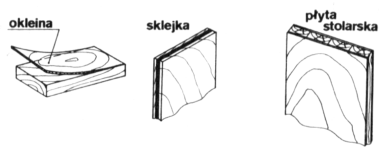
Plywood are boards of various dimensions, glued together with an odd number of veneers, whose fibers cross in adjacent layers. Plain and waterproof plywood are produced. For the latter, water-insoluble adhesives are used. Plywood, compared to solid wood, have many advantages. They do not break, they do not dry out and do not cray, have the same strength in all directions (along and across the grain), but much higher than solid wood of the same thickness. Plywood is much wider than the widest boards, they have a prettier appearance and are more efficient in the production of wood products.
Due to its advantages, plywood is widely used in construction and furniture carpentry, in land transport, water and air, and in many industries. In the DIY workshop, they can be used in many ways to build various utility items, toys, flying and floating models.
Plywood is made of deciduous and coniferous wood: mainly pine and alder; from hardwood (birch and beech) however, they are more durable and have a nicer grain. They are produced in various formats, qualities and grades.
Thickness of normal plywood boards (sheets) is from 3 do 20 mm, length from 1530 do 2250 mm and width from 1200 do 1530 mm. The difference between the successive disc formats is 50 mm. Special plywood (aviation and others) are produced in thicknesses from 1,0 do 4,0 mm.
Furniture carpentry boards are glued together from several layers: a thick middle layer and thin veneer layers (one or two). Depending on the type of wood used for veneering the middle layer, we can find boards with hardwood veneers (alder trees, poplar trees, lime trees, birch trees, maple and beech trees) and conifers (pine or spruce). The middle layer of the board can be glued together from inferior spruce or fir boards, from lower-quality pine and spruce veneers up to 5 mm, from narrow planks or slats.
Chipboards are made of shavings obtained in special machines. They can be one thing- or multi-layer. They are mainly used in construction (chipboard) and recently almost exclusively in construction and furniture carpentry. Carpentry chipboards can be painted, polish and veneer. They are much cheaper and more efficient than solid wood, however, great care is recommended when applying them to furniture and various household appliances, because factory-veneered chipboards emit volatile substances, which are extremely harmful to humans, for the first few months after production, from urea glues used in their production.
by marcin

Category: Information
Tags: veneers (forniry), furniture blockboards, plywood, chipboard and fibreboard