Gluing boards and slats
There are no universal adhesives, which would make it possible to reliably combine different materials. Only adhesives matched to specific types of materials, under certain climatic conditions, guarantee the durability and strength of the joint. Even commonly used epoxy adhesives nevertheless, that they connect metals, they are not universal yet. Therefore, you should understand the properties of the adhesives and how to use them.
For everyone, with no exception, adhesives apply as a rule, that the glued materials are hygroscopic (i.e.. such materials, which react to humidity conditions, e.g. wood, concrete, brick) must be fixed, specific humidity, which for wood is 8-10% (exceptionally 14%), for concrete 1.2-3%.
Preparation of the surface for gluing
The planed surface of the wood is suitable for gluing, similar to sanded. Rough surface (e.g. after sawing on a sawmill) not suitable for gluing. Just accurate (smooth) Widia saw kerf can be glued with special types of adhesives. Glued joints are even more durable, the better the joined surfaces fit together. With increasing thickness of the joint gap, its endurance drops. This is particularly evident when using urea-formaldehyde adhesives. Sometimes the shear strength of thicker joint gaps deteriorates even more. Therefore, it is recommended to use polyvinylacetate adhesives for thicker joints. Some durability of the joint with thicker gaps is guaranteed only by epoxy adhesives.
Gluing boards and slats to increase width
In case of the need to cover some surface with boards or slats wider than these, we have, they should be glued together. In this way, even when butt gluing a flat profile, strong joints are obtained. This is especially important with trepes of stairs, where the required width is 25-30 cm. Such wide balls are very rare. If we even get them, they will be center balls, with the core. Wood around the core, approximately 1-2 cm wide, should be cut, because this is where it breaks and twists (drawing).
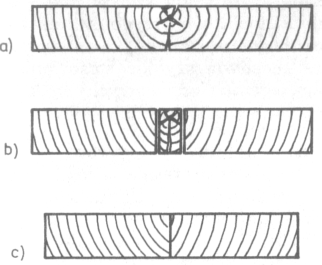
Drawing. Core board repair: a) mid-board with core cracks, b) recommended method of cutting out the center of the width of 2–4 cm, c) gluing the coreless board and its surrounding area.
Shaping the joint profile to increase the contact area is unnecessary. Instead of milling the profiles, it is better to pay more attention to the flat construction, at right angles, flat contact surface.
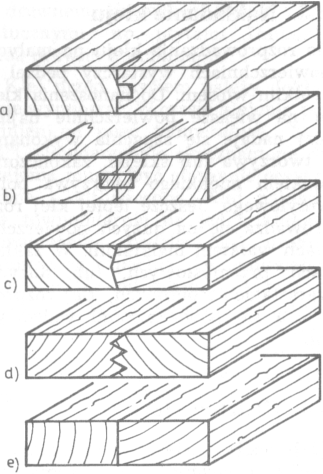
Drawing. Methods of gluing boards and logs to obtain greater widths: a, b, c, d) profiles to increase the bonding surface are superfluous as a firm joint can be achieved without profiling, e) proper execution of the butt joint guarantees high durability.
Smooth and even surface, no unnecessary profiles, guarantees a more durable joint than the glued material. Means, that correctly glued wood is the strongest at the joint. During the tensile strength tests, shear and bending until the immediate strength is exceeded, and damage to the sample, always occurs first outside the glued joint (drawing).

Drawing. When testing the bending strength of the joint (shear, stretching) the wood is split apart from the joint: a) glued sample subjected to bending by force F., b) section after fracture, after exceeding the immediate strength of the bonded material.
Applying glue
A short-haired brush is enough to spread the adhesive over small areas. A putty made of plastic or plywood is best suited for applying the adhesive to larger surfaces, finished with a strip of soft polyvinyl material. Even better, the glue is spread over large surfaces with a paint roller. In industrial plants, or large carpentry workshops, the glue is spread with roller coaters.
