Safety when working on woodworking machines
Safety when working on woodworking machines
All of you, who work with wood today, even hobbyists, they use woodworking machines or at least working tools. Description of the structure and use of them can be found in numerous publications. Mimo that, at this point, we must mention the principles of safe work with machine tools and power tools. Accident statistics show, that the most injuries occur with woodworking machines, the most dangerous of which is a circular saw.
So what to do, to prevent any kind of injury? The first condition is to follow the safety regulations for each machine tool. The second basic condition is to concentrate fully on your work, anticipating the possibility of different behavior of the processed material, jams, reflections etc.. The third condition is that the machines are properly prepared (sharp working tools, shields attached and other auxiliary protective devices used).
Even when machining by hand, injury can occur, however, they are not as frequent and as heavy as with machining. Order in the workplace, necessary work surface, which contains only the tools needed to perform a given operation, means further conditions for safe work and good organization of the workstation, which favor smooth production. An example of the arrangement of hand and power tools is shown in the figure.
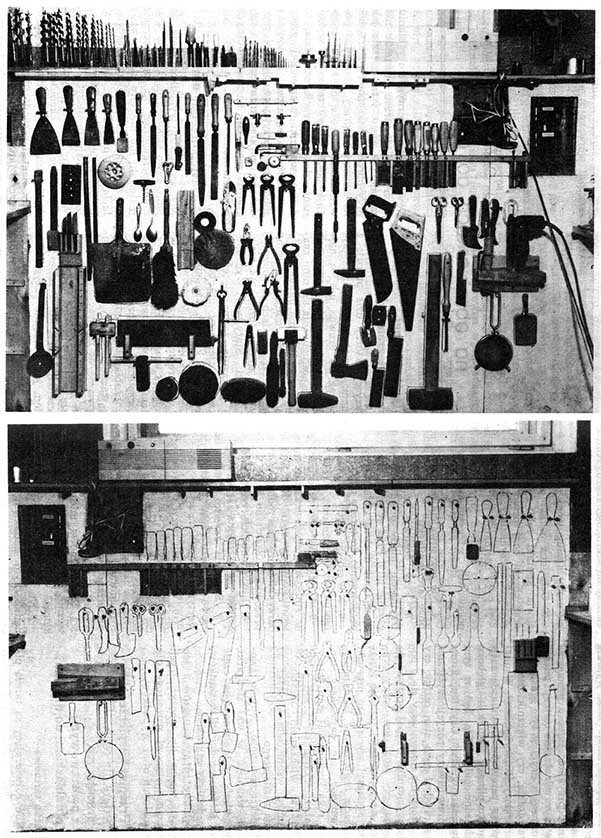
Arrangement of tools on the wall; chipboard is screwed to the wall, to which the hooks are attached, spikes and fittings adapted to the shape of the tools. The plate with the tools is painted with the spraying method. The outlines of the tools on the plate make it easy to return them to the right place.
Unnecessary injuries
Not all accidents can be prevented equally. It is much more difficult to predict, for example. jam of material or some hidden defects of machines and working tools. It is much easier to predict some so-called. unnecessary injuries, for all sorts of reasons. Let us mention a few examples.
Soon after finishing work and switching off the circular saw, the worker reached for the still rotating saw blade., to check, whether it has overheated. At this point, the saw was running quite high. The worker thus lost three fingers of his right hand.
Another example: one of the employees was checking the condition of the circular saw blades, and the other at that time, without checking, is the switch in the "off" position, plugged the cord into the power socket for the saw. Effect - deeply injured fingers. Who was to blame in this case? Whether this, who, without checking the switch position, checked the condition of the blades with his hand, whether this, who, without confirming the position of the switch, inserted the wire into the socket, or maybe this one, who worked on the previous shift and turned off the machine by pulling the cord from the socket? Everyone made a mistake, but the greatest one, who controlled the condition of the blades with his hand, without protection against accidental switching on of the machine tool, i.e.. before inserting the plug into the socket.
Loose knives, only inserted freely into the planer shaft, when turned on, they "took" part of the table with them. You can guess the effects, if they had reached a man.
There are many examples of various injuries and their causes. Let these few serve as a warning to potential accident victims.
Safety regulations and advice for people working with basic woodworking machines
Circular saw
1. The opening wedge behind the saw blade can be the maximum 0,5 mm thinner than the kerf width. The wedge prevents the saw from jamming in the kerf and preventing the material from being bounced towards the saw operator.
2. The protective saw guard prevents hand contact with the saw blade and protects the eyes from sawdust and various shavings.
3. When cutting lengthwise material, use a feed paddle with a square cutout!
4. Do not put your fingers near the saw blade!
5. When advancing the material, never keep your fingers in the plane of the saw! With possible splitting of the wood, they would go directly to the saw blade.
6. Never stand in the plane of the saw!
7. Do not leave scraps on the table; always remove them from the table with a spatula, never with your hand! Saw blades not removed may hit the employee's face.
8. Don't walk away from the machine tool, until the saw blade stops!
9. Always use circular saws with well-sharpened and set teeth!
10. Near large knots, for cracks and fiber deviation, slow down the feed and pay attention to the operation being performed!
Bandsaw
1. The bandsaw blade must be sufficiently taut and guided towards the elephants.
2. Do not overload the machine tool with excessive pressure on the saw blade.
3. Holding sawn wood, keep your fingers away from the bandsaw.
4. No other activities should be carried out on the table while the saw is in operation.
5. A support stand should be used to cut long boards.
6. After noticing "beating" of the band saw, the machine tool should be stopped immediately, because the tape was probably torn.
7. If the band saw blade comes off the drive wheels, jump away from the machine and turn it off immediately. The table can be approached again after the machine tool drive has completely stopped.
Planer, planer
1. When planing short workpieces, set a low feed, and move the wood with a spatula.
2. It is not allowed to remove chips from the gap between the shaft and the table while the machine is working.
3. The processed wood must be held securely in the hand! Do not spread your fingers!
4. A protective cover over the planing head should be used.
5. When advancing the wood, the hand must never be near or above the head. Therefore, initially both hands should press the workpiece against the table. The left hand should usually be in the front. As soon as it is a few centimeters in front of the head shaft, place it over the rear table, moving the workpiece with your right hand. If the length of the processed material allows it, the right hand should also be transferred to the rear table after reaching the shaft.
6. When processing knotty material, with an abnormal fiber course or cracks, slow down the feed and be careful for cracks, grafts or fractures.
7. Increased attention should be paid to adjusting and tightening the blade bolts! After replacing and screwing them on, check their fixing again.
8. Do not leave the machine while replacing the knives.
9. Only sharp knives should be used! Dull knives cause the material to vibrate and increase the risk of it slipping out of hand control.
Thickness planer
1. Do not face the machine when picking up the workpieces! A chip or knot that is ejected may injure the face.
2. The same rules apply to replacing the knives as for the planer.
3. Do not stand straight when inserting components into the machine, to a thrown item (reflected) did not hit the attendant.
