Wooden cottage Anna
Gable walls
The supporting structure of the gable walls is made of skeletal battens, to which the boards are nailed from the inside, e.g. plasterboards, chipboard, soft fibreboards etc.. From the outside, the skeleton is covered with chipboard impregnated with varnish twice, possibly covered with plaster. The end walls are insulated with mineral wool (ew. woody) placed between the wall cladding.
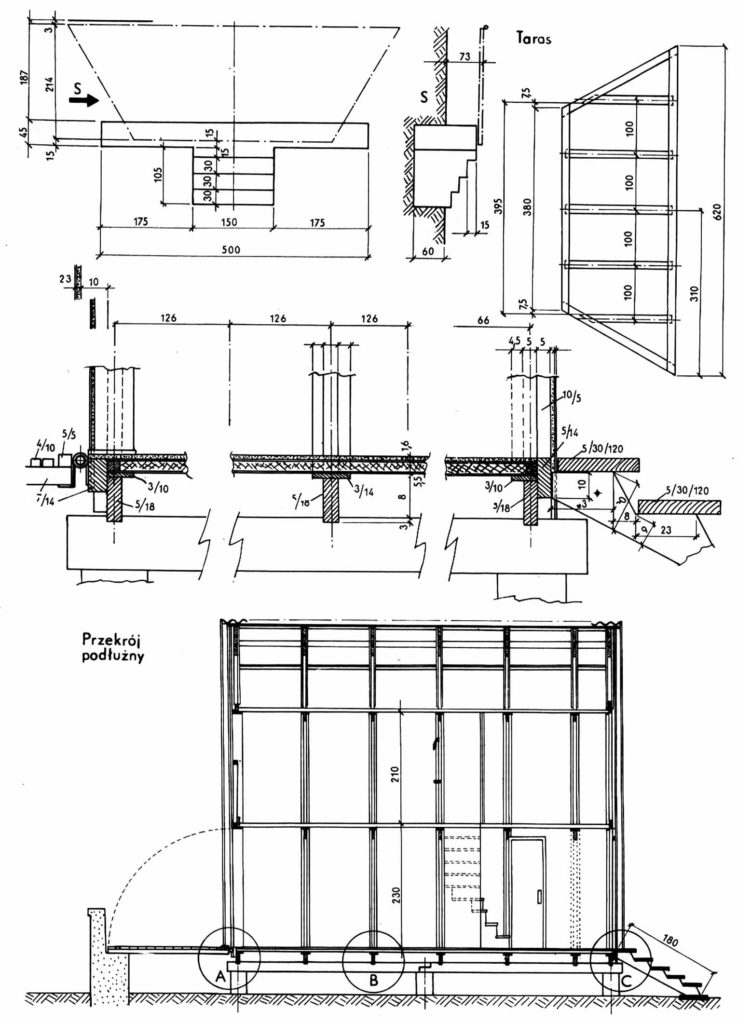
Taras
The terrace has a trapezoidal shape, so that after applying it to the gable wall {with patio doors) creates one large shutter reaching up to the first floor. Hinge, on which the terrace is rotated, is located in the plane of the ground floor. The terrace is made of wood and its load-bearing structure consists of two caps with a cross-section 7/14 cm and stringers with a cross section 7/14 cm, spaced apart at an axial distance 100 cm. A floor made of boards with a section is laid on the structure 4/10 cm. The deck is lifted by a steel rope around a steel roller attached to the bracing tongs.
Partition walls
The supporting structure of the walls is made of pillars, to which chipboards or plasterboards or other are attached on both sides, possibly boards.
Ground floor
The supporting structure of the floor is made of floor panels covered with chipboards over the entire surface of the ground floor.
The chipboard surface is covered with a chemically hardened varnish. The attic floor is resolved similarly. Of course, a traditional plank floor can also be used.
Plumbing
The cottage is equipped with a water supply system from the public water supply or from a well, from which water is drawn manually or electrically into a large-capacity tank. The tank is best placed in the bedroom 2. Water is distributed from the tank to individual collection points. Water pipes, just like electric, leads in empty spaces, between the sheathing of partition walls. It is done this way, that after placing the pillars and the sheathing on one side of the wall, wires are laid inside the walls, access to electrical boxes and holes for the outlet of the water supply system are drilled in the inner sheathing, boxes and sockets as well as water fittings are deposited on the side of the sheathing, and then the missing wall plating is nailed down. Horizontal electrical cables are led along the floor and covered with a skirting board.
Heating
It is assumed that the interior is heated with oil stoves by the Truma system, but in our conditions it is difficult to achieve, which is why – in case of using the house also in winter – the only real solution is to install electric storage heaters. One stove that is adapted as a kitchen stove is placed in the kitchen. The flue is led out through the bedroom, in which an exchanger is placed to heat it. Other stoves are placed in the living room, and their exhaust pipes are led through the second bedroom, which is heated by the same exchanger. In the space above the attic, the exhaust pipes are bent like this, so that after passing over the roof they can be grouped and led out as a masked traditional chimney with a roof protecting the pipes against snow and rain.
