Wood floor – parquet – mosaic tiles
The qualification of the staves to individual quality classes is determined by wood defects and the quality of processing. Fine grain staves, finely and evenly patterned, without major anatomical defects of the wood on the visible side, are usually classified as class I or II quality. Also, the accuracy of execution in the first two quality classes must be high. The facing surface must have a perfect rectangular shape and must be completely smoothly sharpened. The profile front and side planes should also be smooth and the grooves and tongues at the same level. Deviations in the dimensions of the tongue and groove are unacceptable, because it makes it difficult, and even makes it impossible, connection of the planks during the laying of the floor. The tolerance of the width dimensions in the first two classes should not exceed ± 0,2 mm, and length ± 0,5 mm. Larger dimensional deviations are allowed in the 3rd quality class, as well as the disadvantages of wood and processing. A plank in the 3rd quality class is suitable for floors only in less representative rooms and with the use of simpler laying patterns.
The moisture content of the floor plank is 8-10%. One of the indicators of the greater humidity of the staves is greater, oversize their width. If we find a width measured in the middle of the length that is at least by 0,5 mm from the nominal dimensions, it means moisture in transport or in storage, or its improper drying in production. Such a strip should be dried in stacks in a well-ventilated room with central heating.
The drying period depends on the degree of moisture, i.e. the size of the width deviation from the nominal dimensions.
Large dimensional deviations in the length and width of the plank, especially positive and negative, either indicate poor machining quality, or improper sorting of the staves before packing and shipping. Staves with large positive and negative width deviations are only suitable for laying simple floor patterns. On the other hand, planks with larger length deviations are not suitable for the floor at all.
The floorboard is sold in packs. Approximately this number of staves is included in the package, that the surface arranged with them gives 1 m². There is always an even number of staves in the package, half of which are called. left and half right. If looking at the face of the stave in a hand, we can see the feather on its upper forehead and right side - we are dealing with the right stave, if, at the same position, the tongue falls on the upper forehead and on the left side - it is a left plank (drawing).
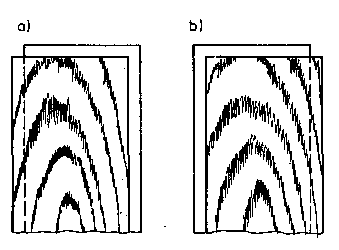
Drawing. Types of staves: a) right stave, b) klepka lewa.
This arrangement of feathers allows you to arrange the floor in a herringbone pattern, as well as some other patterns.
Skirting boards are the materials for finishing the edges of the floors (wall) and plinths. Skirting boards and plinths are made of the same wood as the flooring. The main dimensions of the slats are: width - 30 mm, height - 23 mm, length - from 1 m up
with gradation of what 0,1 m. However, when finishing the edges of the floor, the dimensions of the battens are not as important as their cross-section. Examples of several different cross sections of the battens are shown in the drawing.

Drawing. Skirting boards cross-sections: a) the so-called. quarter round, b, c) profiled sections.
Due to the unevenness of the walls, as well as flooring, the skirting boards should have an opening angle between the contact planes greater than 90 °. Ideally, the aperture angle is 120 °.
The plinths most often have a rectangular cross-section with a rounded top, the outer edge. The width of the plinths usually ranges from 10 do 15 cm, thickness - approx 20 mm, length - similar to skirting boards.
