Wood floor – parquet – mosaic tiles
Wood floor – parquet – mosaic tiles
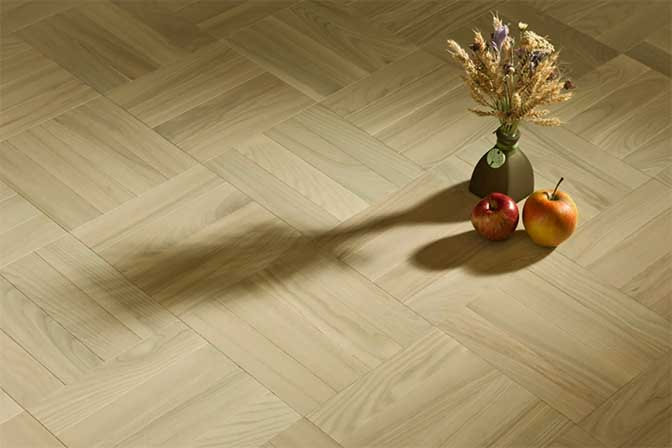
Mosaic tiles are a fairly common flooring material. They are made of hardwood slats (most often oak) arranged sideways, strictly next to each other, in such a number, so that the sum of their widths is equal to the length of the slat. The board has a square or rectangular shape and the slats included in it are temporary, or permanently, connected by a bonding material in the form of paper or mesh. The floor has a dampness 11%.
Each mosaic tile is included 16 sets with five slats included (drawing).
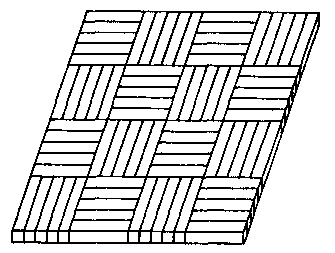
Drawing. A mosaic floor slab made of 16 square sets of slats
The most common plates in the trade have dimensions 10 X 400 X 400 mm.
Mosaic floor slabs are produced in three quality classes. In the third quality class, numerous wood defects are allowed on the upper surface, like bigger knots, cracks, colors, etc.. Therefore, when buying this type of board, you should take into account quite a lot of waste, or a poorly aesthetic floor. Moreover, the permissible dimensional deviations of the length and width of the boards should not exceed ± 0,5 mm. The larger dimension proves that the moisture content of the wood is higher than allowed by the norm.
The most famous and widespread flooring material are floor staves, commonly known as floor planks. In Poland, they are produced by the wood industry plants, artisans as well as private manufacturers. The sale also includes an imported strip.
The floor plank is in the shape of cuboids. Its sides and foreheads are provided with a suitable profile in order to connect the planks to each other.
Drawing. Various sections of floor slats (klepki).
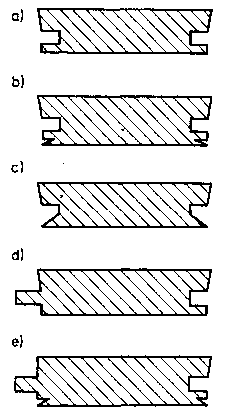
Depending on the type of substrate and the method of fixing, there are five basic profiles:
a) an ordinary strip with a four-sided groove, connected with a foreign tongue and nailed to the base with nails,
b) a universal plank with a four-sided inlet and an additional groove below the inlet, connected with a foreign tongue and attached to the base with glue or nails,
c) asphalt stave with a four-sided groove on the sides,
d) an ordinary plank with a tongue and groove, which has a key on one side and forehead, on the other side and forehead - feathers, fixed to the base with nails,
e) universal plank with tongue and groove, with the same profile as the previous ones, but equipped with an additional groove around the perimeter on the opposite side, fixed to the base with nails or glue.
With the exception of asphalt staves, the rest are suitable for floors in residential buildings, and public utility buildings.
The floor plank is made of various types of wood. Most often it is made of hard species of deciduous trees. Most staves are made of oak and beech, the species of ash go further rather occasionally, birch trees, maple tree, grabu, elm, olchy, robinia and wood from fruit trees. Pine wood staves have also appeared recently, fir and larch.
The best plank is made of oak and ash wood. An oak or ash floor is durable, easy to maintain and highly aesthetic. A disadvantage of beech flooring is the tendency to warp and crack due to the high shrinkage of the wood, and the common mushroom infestation. Birch wood floors are very nice. However, they require constant maintenance due to their light color and easy contamination. Softwood flooring, e.g. pines or alders are fragile. They are easily rubbed off, leave permanent traces (prints) on furniture and even the heels of shoes. Due to their high flexibility and friction coefficient, they are suitable for gymnasium floors.
The floor plank is manufactured in three quality classes, and various dimensions. Due to the thickness, a thin strip is distinguished 16 mm, a strip of normal thickness 19 mm and a thick strip - 22 mm.
Drawing. Fragment of a cross-section of a plank with the thickness of the wear layer marked.
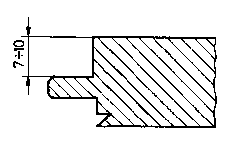
For practical reasons, the thickness of the wear layer is important (drawing), which for thin staves is 7 mm, normal 8-10 mm and thick 10 mm. The dimensions of the length and width of the planks vary. The length of the floor planks varies between 20 and 95 cm with every gradation 5 cm. The width is from 50 do 120 mm with gradation every 5 mm.
