Wood floor cost planning and material specification
The next stage of the implementation of our plans is the purchase of the necessary materials. When going to the flooring point of sale, you absolutely need to take a caliper and a tape measure with you. They will be used to control the nominal dimensions of the purchased material. The dimensions should be consistent with the mark on the packaging. Oversized dimensions are an indicator of excessive moisture of the offered material. Alternating dimensions, below and above normative, indicate inaccurate processing or bad sorting. If, nevertheless, we decide to buy such materials, it should be taken into account, that in the first case it will be necessary longer, more than a month of seasoning, and in the latter case, sorting will be a necessity.
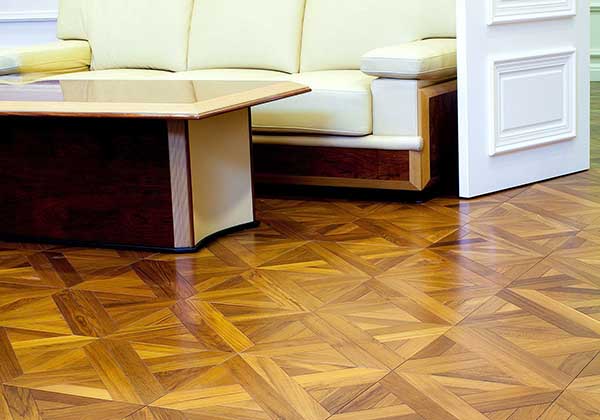
The hardest thing is to buy a parquet. This is due to the large variety of the offered range in terms of dimensions, quality class and type of wood, as well as the richness of patterns that can be arranged. It often happens, that our apartment is missing a strip of the same dimensions, in the same quality class and type of wood. Well then? There are two solutions. Or we decide to buy a different plank for each room and separate it when laying with a threshold, or we decide on a different pattern. The laying patterns and their influence on the bidza's dimensional requirements are discussed in the next chapter.
The final stage of preparatory work is planning the flooring works schedule. The data given below should be considered indicative. It is difficult to assess the dexterity and manual skills of individual performers - amateurs.
On the arrangement 10 m² of parquet flooring is required from 4 do 7 man hours. The time standard for laying the floor takes into account the number of staves placed on 1 m² of surface and laying pattern. E.g. for a herringbone arrangement 10 m² of a plank floor with dimensions 60 X 300 mm consumes approx 5 hours. The laying time of a mosaic floor will of course be shorter, because on 1 m² of floor space, it's necessary to, only 6,25 pieces of plates with dimensions of 400X400 mm. For olives 10 m² of floor space is needed 1 man-hours.
Between the flooring and finishing works there should be at least a 10-day technological break devoted to the bonding of the adhesive with the substrate and the floor. (drying of the glue). The planed timber floor does not require such a break.
Finishes include sanding and polishing or varnishing. As long as sanding can be done in one pass, painting works also require technological breaks. For mechanical grinding, one-time 10 m² of flooring is approx 40 min. In general, parquet requires three sanding with abrasive cloth 😮 of decreasing granulation. Only two-fold mosaic floor.
One-time painting with a brush 10 m² of space lasts on average 1 time. Because the drying time of the Capon varnish undercoat also takes an hour, therefore the first layer of chemo-curable varnish or paste can be applied immediately afterwards. However, the drying time of the varnish, depending on the type, lasts from 6-12 hours. Because you should apply a three-layer chemically hardening varnish and it is good to sand the floor by hand after applying the first layer, this operation must take at least three days. In the case of pasting, this time can be limited to one day, and in the case of a plank floor it is not considered at all. The floor boards have a factory-finished surface.
To sum up, flooring works with finishing, e.g. 50 m² of floor space, will last for a period of approx 18 days, including the 8-hour working day and the necessary technological breaks, The amateur tiler will take much longer to complete them.
