Wood floor cost planning and material specification
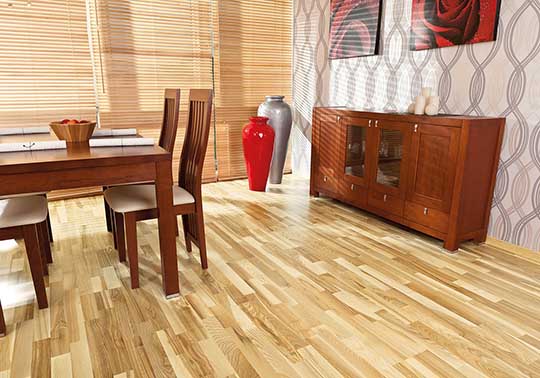
Finally, one more general note regarding the choice of flooring material. The smaller the room, the smaller the dimensions should be a plank or planed floor sawn timber. This is related to the aesthetic qualities of the floor and the always achieved higher quality of laying. Because there are more joints in the floor, the smaller the gaps between them will be, which we will never avoid. These are the natural properties of wood.
Before starting the material specification, make a sketch of the apartment with the exact dimensioning of individual rooms, corridors, hallways and alleys, which we intend to cover with wood. Then calculate their area, and plan the laying pattern.
In the case of the parquet, it is mainly about this, whether the entire premises will be lined with one continuous pattern, or whether individual rooms will be separated from each other by thresholds.
This may have an impact when purchasing materials.
The material specification should contain three groups of items: flooring materials, finishing materials and auxiliary materials.
Flooring materials must be calculated with an appropriate margin. Generally speaking, the stock should be from 5 do 10% the total area of the floor to be covered, wherein, the lower the quality of the material, the stock should be closer to the upper limit. In addition to the area reserve, in the case of boards, a reserve of length also comes into play. Floors made of boards joined along the length in the middle of the room look very unsightly.
The finishing materials include pastes, waxes and varnishes. In general, the manufacturer indicates the average yield of these materials on the packaging. Due to the multitude of them, the author gives here only an example of the most common finishing materials. Performance with 1 1 of the base capon varnish is 12-15 m² of the surface painted once. The coverage of the chemosil chemically hardening top lacquer is 10-12 m² of the surface painted once.
Each liter of chemically hardening varnish is used up 0,044 l "Utosil" hardener.
The auxiliary materials include binders, abrasive cloth, nails and brushes. The "Mazolep" glue is used to stick mosaic tiles.. 1 kg of glue is sufficient for sticking 4 m² of mosaic tiles.
You need glue to stick the parquet. On 1 m² of parquet floor space is used up 1 kg. Also for sanding floors (except for floor boards) an abrasive cloth of three is necessary (or two, in the case of mosaic tiles) different grain sizes. A cloth with a grain size of 10-20 is suitable for coarse sanding, for medium - grain size 40-60 and finishing smoothing - grain size 120. Canvas sheets with dimensions 200 X X 600 mm are placed on the working drum of the floor sanders. For every 10 m² of surface area, on average, one sheet of abrasive cloth from each granulation is used. In addition, a few small, fine-grained sandpaper are required (e.g. 120—160) for removing hairline wood fibers from surfaces, after the first painting. Abrasive cloth due to the low strength of the carrier (canvases) it is recommended “with more headroom (e.g. 50%). Nails with dimensions are used to fix the skirting boards 30 X 2,5 mm. On 50 meters of slats are enough of them 0,20 kg.
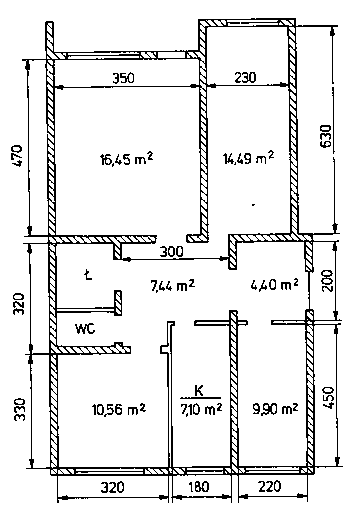
Drawing. Sample dimensional sketch of an apartment.
An exemplary sketch of the apartment with dimensions is given in the drawing. The table shows the material specification and approximate material costs for the apartment shown in the sketch.
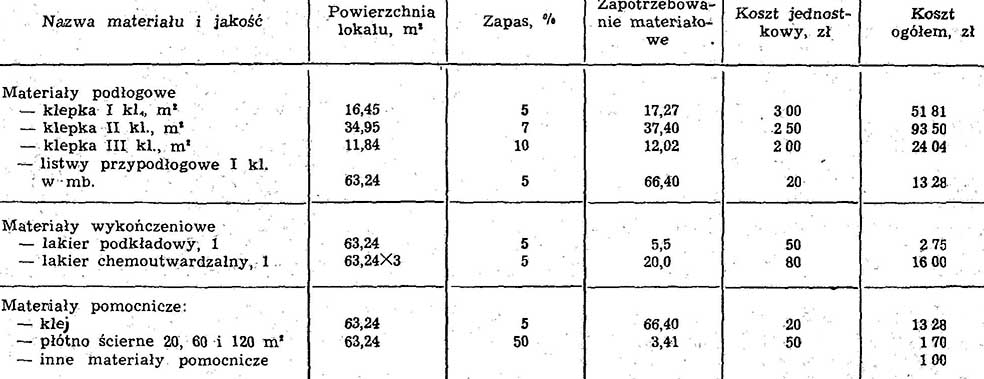 Total material costs 21 736 zloty.
attention: Four rooms - arranged in a herringbone pattern, hall and corridor with a brick pattern. The rooms are separated from the hall by a stave threshold.
