Compacting concrete in the foundation
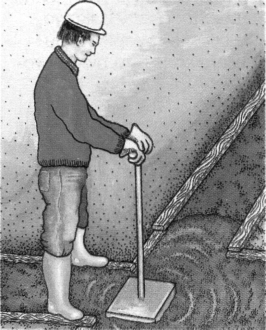 Compaction of concrete in the foundation by tamping
Freshly laid concrete contains voids (vainly) and air bubbles, which, after it hardens, reduce strength. Concrete should therefore be compacted, so that it obtains a uniform structure. Damp concrete (KW) thickens by tamping. A rammer or is used for this, for small quantities, slats. Concrete is placed in layers up to 15 cm. With too thick layers, tamping is ineffective. Concrete keeps compacting, until its top surface becomes moist and sealed. Particular care should be taken to tamp along the formwork and in the corners. Concrete should compact to this degree, so that a carefully placed foot almost does not make an impression. Plastic concrete can be compacted by centrifugation using a vibrator with a motor drive. If there is no vibrator, a rammer may be used. Semi-liquid concrete (KPC) mixed with a slat, so that the air contained in it escapes upwards, or it is thickened by tapping on the decking boards. It should not be centrifuged. On the other hand, liquid concrete with a plasticizer can be laid without compaction.
Concrete processing time
Concrete should be processed immediately after mixing it, or, in the case of concrete from a concrete plant, immediately after delivery. It should be thickened, before it gets too hard.
Prevention of desiccation
That the concrete obtains full strength during hardening, protect it from drying out.
If the concrete dries too quickly, it reduces its strength, deteriorates the quality of its surface and can lead to the formation of cracks. Especially in warm weather, it should be constantly moistened with water. In strong sunlight, its surface is additionally covered. Fresh concrete should be moistened to 7 days.
