Concrete mixing
Concrete mixing
Manual mixing
When working with small amounts of concrete with strength classes B7.5 and B10, manual mixing is allowed. A clean substrate is required for mixing, e.g. A sheet of metal is well suited for this. Aggregate and cement are dry mixed at least twice, until the mixture is uniformly gray in color. While stirring, we constantly add water from a watering can and we have to mix the ingredients twice until a homogeneous concrete mass is formed.
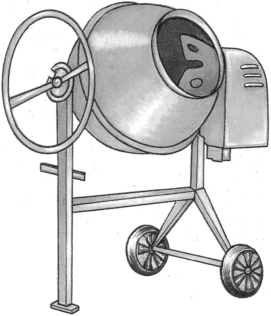 Mixing in a concrete mixer
Mixing with a concrete mixer is better, because the ingredients are better mixed with each other, which improves the quality of concrete. The mixing time should be at least 1 a minute. Add to the mixer successively: aggregate, sand, cement and water; dry pre-mixing is unnecessary. Concrete mixer with a volume 250 And it produces a mass of approx. 16 m3 of hardened concrete. To be crafted 1 m3 of concrete mass prepared in a concrete mixer, approx. 1,3 m3 of aggregate, i.e. approx. 2 t.
The proportions of the ingredients
To be able to determine the strength class of concrete in advance, the proportions of the mixture components for each strength class should be kept quite accurately. The cement and aggregate should be measured in proportion, i mas (which corresponds to their weight proportion). On a small construction site, measuring according to mass proportions is quite difficult. In practice, however, we measure the components of concrete with a shovel, that is, according to the usual volumetric ratios. The values in the table above are indicative of higher aggregate content. For fine aggregate, more cement should be added (10 do 20%).
When working concrete for foundations, which will not be particularly burdened, for baseboards or other building elements, dosing can be simplified, by measuring the ingredients with a dry bucket according to the volume ratio. There is one bucket of cement 5 aggregate buckets. For any other purpose on 1 a bucket of cement is used 4 buckets of aggregate. Mains water or rainwater can be used as mixing water. Water with organic ingredients, e.g. surface water, not suitable for this.
If necessary, concrete admixtures such as plasticizers can be added to the mixing water, pore-forming agents, and others.
The amount of ingredients per 1 m3 of concrete mix
| Grade | Consy | Cement (w kg) brand | Aggregate Water | Weight ratio | |||
| concrete | stency | 25 | 35 | 40 | kg | I | cement: aggregate |
| B7,5 | KW | 150 | – | – | 2224 | 111 | 1:15 |
| B7,5 | KGP | 194 | – | – | 2038 | 154 | 1:10 |
| B10 | KW | 186 | – | – | 2172 | 118 | 1:12 |
| B10 | KP | – | 210 | – | 2096 | 154 | 1:10,5 |
| B15 | KW | – | 217 | – | 2141 | 124 | 1:10 |
| B15 | KGP | – | – | 159 | 2000 | 158 | 1:7,7 |
