Reinforcement works
Reinforcement works
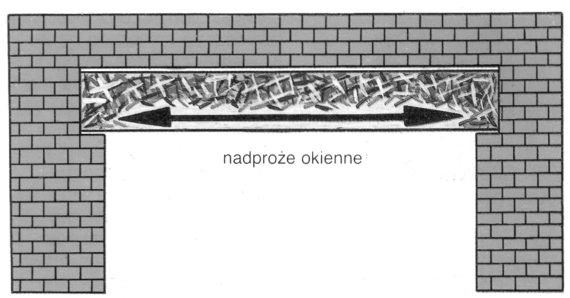 There are tensile stresses in the lower part of the window lintel, so rebars should be placed there.
 In the bracket, for example in a balcony slab, tensile stresses occur in the upper part, so that is where the reinforcement should be placed.
Place, the shape and method of laying the reinforcing steel are determined on the basis of strength calculations and the reinforcement drawings included in them. In addition, there are several rules that must be followed during reinforcement works. Reinforcing steel should always be placed in the building element in this place, where tensile stresses occur. Depending on the type of load, this site may be the lower part, like for example. in the window lintel.
In the middle of the window lintel, there is a maximum load from the wall and the ceiling above it. It, in turn, causes compressive stresses in the upper part of the lintel and tensile stresses in its lower part.. On the other hand, in the balcony slab support shown in the illustration, the tensile stress occurs in the upper part of the slab. During assembly, therefore, pay special attention to the place of laying the reinforcing steel and secure it with binding wire and spacers.. If, during concreting, the reinforcing bars on the top slide down due to pressure, the standard resulting from strength calculations will no longer be maintained, the strength of the structure will decrease. As a result of the downward movement of the upper reinforcement by 2 cm, the load-bearing capacity of the balcony slab may decrease by 20%. The upper reinforcement is placed on the spacers before concreting or only when applying the concrete. Reinforcement should not be placed unsupported, because then it would not be possible to check its position. There are different forms of washers: made of plastic, concrete or steel. Pictures on this page, show several types of them. Depending on the diameter of the steel, the distance between the washers is 50-100 cm. They are inserted between the reinforcement and the boards (formwork) or pressed against rods. They ensure a minimum coverage of steel with concrete and maintain the correct distance between the bars and meshes.
Technological principles
Reinforcing steel must be wrapped around with a sufficiently thick layer of concrete to protect it against corrosion. Reinforcing steel is cleaned of loose rust before use, dirt and grease, so that it can permanently bond with the concrete. Rods, the reinforcement mesh and the pads must be firmly connected to each other to such an extent that they do not move during concreting. To connect reinforcing bars together, ties wire is used. It is a steel wire in diameter 1-1,4 mm. The tie wire is processed with reinforcement pliers or ordinary pliers. The joints are wrapped once or twice with a wire loop, and then the wire is stretched with pliers, so that the joint is firm.
