Water instalation
Water instalation
Water for the needs of the building can come from its own water supply or from the public water supply. In the first case, the water supply system includes:
o a well that gives a sufficient amount of water; o a pump pumping water from the well;
o a water storage tank;
o pipes distributing water to individual parts of the house.
If there is a natural clean spring near the cottage, it can practically be used for water supply. By making a low wall separating the outflow from the source and deepening the spring, the water will be retained and can be drawn for the needs of users. Instead of digging depressions, we can build a tank out of concrete or bricks, with a number of holes on the upper side, through which spring water flows and accumulates. There is an overflow on the lower side, which the excess accumulating water flows out, or the tank wall has openings, which the water seeps into the surrounding ground. Such a well tank can be improved by dividing it into a settling chamber and a drawing chamber. The water flowing into the settling chamber is cleaned, and then flows into the drainage chamber, where it can be taken with a cable for the needs of the house and transferred to the outlet trough via an overflow.
ATTENTION! Before water is supplied to the cottage construction site, it must be checked in the appropriate sanitary and epidemiological unit, whether it is drinkable. Water from ponds, ponds, lakes and rivers can be used not only for bathing and washing, but also for drinking (after boiling), if they are not contaminated by harmful fluids.
When the groundwater is not too deep, which can be determined by trial drilling, we can dig the well ourselves. For this purpose, you should equip yourself with concrete rings with a diameter of not less than 100 cm, so that the digging of the well opening is not too burdensome. The well should go deep at least 1 m into the groundwater layer, so that at low groundwater levels it is possible to collect it. The topmost circle should protrude 25 cm above the surrounding ground, so that the surface water does not run into the well opening, and be covered with a tight cover. The well is covered with a board made of wooden or reinforced concrete logs. A cable with a hand pump is inserted through the hole in the plate.
 Discard excess soil around the well, and the place should be paved with stone or rubble. Otherwise, we put on an additional circle and draw water with the help of a bucket and a steel rope.
ATTENTION! Under no circumstances may any water spilling out during the intake flow through the ground back into the well.
If the groundwater is deep, this water device is made by a craftsman called a well. The water from the well can be lifted with a hand pump, the so-called. Abyssinians, or by using an electric pump. In the latter case, it is necessary to use a pressure tank for filling the water supply lines. Various pump companies make small ones available, complete aggregates. Their sizes are so limited, that they can be placed in the smallest space without any special foundations. These pumps work automatically. In winter, unused hydrophore units must be cleaned of residual water, to ta, freezing, did not blow up the pump.
The convenience of the cottage's own water supply with an upper reservoir is significant.
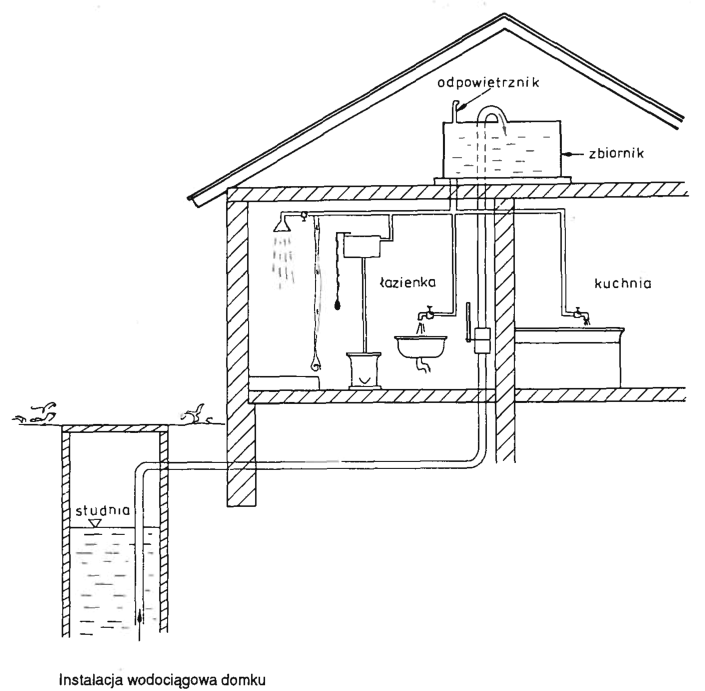 A simple pressure-limited distribution device can be used for home and garden needs. We usually place the tank in the attic above the ground floor, remembering that, to: be made sound and strengthened, brick support of the tank (taking into account its own weight and the weight of water – 1 m3 of water weighs 1000 kg), ensure easy access to it for cleaning or repair and automatic water drain in the event of overfilling the tank.
ATTENTION! In winter, the tank must be insulated from the outside to protect against freezing. We can enclose it with a chest for this purpose, and the space between the walls of the box and the tank – ok. 25 cm wide – we fill with insulating materials, such as: dry needles of spruce, peat dust, sawdust mixed with powdered lime, etc.. Such insulation protects against freezing in winter, in summer, before the water in the reservoir heats up.
In the second case, the domestic pipeline consists of three types of pipes:
o branches from the upper supply pipe, which we run in the basement;
o from the main water pipe;
o branches leading to these rooms, where water is needed.
