Wall panels made of wood-based panels
Wall panels made of wood-based panels
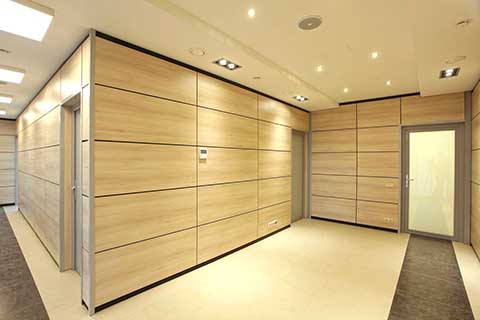
Raw wood-based panels (chipboard, hardwood) they are not suitable for wall panels without a special surface finish.
Some manufacturers of these boards, however, produce specially finished and profiled elements suitable for decorative lining of walls and ceilings.. It is basically this surface finish, which is an imitation of wood. From the aesthetic point of view, these elements never equal the natural structure of solid wood. However, they have their own advantages. First of all, they are highly resistant to weather conditions.
Carpet tiles and Werzalit building profiles
Werzalit products are shaped particle boards with a specially finished surface. They are mainly produced as lining material for internal and external walls, ceilings, terraces, balconies, cornices, attic, window sills, garage door, sports halls, indoor swimming pools, railings, fences, flower boxes etc.. The surface of the moldings has a waterproof coating. It is also not damaged by weak acids and bases. High resistance to weather conditions is due to the melamine foil, under which is the second, decorative foil layer. The decorative layer may be of various colors, in patterns or an imitation of a wood drawing.
Carpet tiles in the 614X614 mm format have a peripheral reinforcement frame and an internal surface either flat or convex.
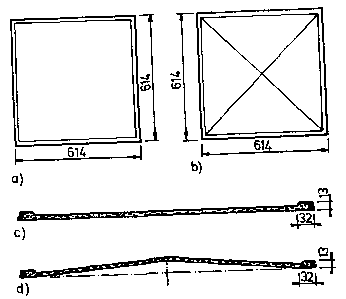
Drawing. Werzalit type carpet tiles: a) flat, b) convex, c) cross section of a flat plate, d) cross section of a convex plate.
The manufacturer, along with the elements, also supplies appropriate mounting brackets.
Building profiles are produced in several types, which allows them to be widely used in vertical and horizontal floor coverings.
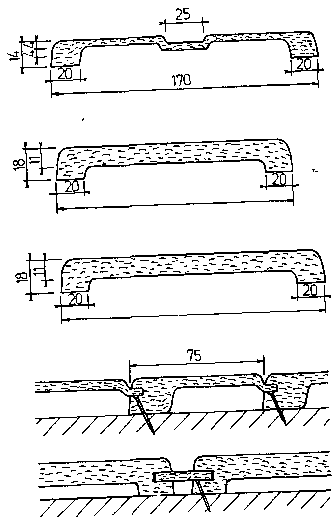
Drawing. Building fittings of the Werzalit type (the length of all fittings is 1800 mm).
The connection elements are provided by the manufacturer.
Laminated chipboards
Double-sided laminated chipboards (or chaff) They are mainly used in the production of kitchen furniture and built-in wardrobes. With the appropriate selection of the size of the elements and the finishing of the perimeter surfaces, they can be used for lining walls and ceilings.
Some difficulty in finishing the perimeter of the board is the necessity to sand its edges. The sides can be covered with foil similar to the one on the board. Tools must be sharp when cutting laminated boards. Carbide-tipped saws are best used.
One-side laminated fibreboards
The boards have a surface similar to laminated chipboard. The load-bearing part is a thick hardboard 3,3 mm and dimensions 1830X2700 mm.
Laminated fibreboards are used everywhere, where a refined surface is required. They can be glued to frame structures. It is not recommended to stick them directly to the wall, because it creates high stresses causing the plates to peel off.
Painted and varnished fibreboards
They are hard thick fibreboards 3,3 mm saturated with dye and varnished on one side. This material can be used for wall and ceiling coverings with lower aesthetic requirements. In addition to sticking boards to frame structures or nailing to a dense grate, they can also be glued to even and smooth plaster. One day before gluing, the boards should be moistened with water. It is best to rub the reverse side of the board with a sponge saturated with water or spray them in the amount 150 g of water per 1 m² and stack them horizontally. Increasing the humidity is necessary, because the boards are manufactured in a very dry state and, after installation, absorb moisture from the air. This causes swelling, increase in dimensions and, as a result, deformation.
Soft fibreboards
This type of panels is only suitable for lining walls in storage rooms. After installation, it is recommended to paint the boards twice with latex paint. They are also perforated, soft fibreboards, which are used as sound-absorbing lining.
Pressed, veneered chipboards
These boards are covered with a decorative one, natural veneer. After the side planes are finished and the joints are made, the walls and ceilings can be covered with them. The boards are produced in three thicknesses 15, 19 i 21 mm i wymiarach 1220X2220 mm.
