Sanding parquet, mosaic tiles and plank flooring
Sanding parquet, mosaic tiles and plank flooring.
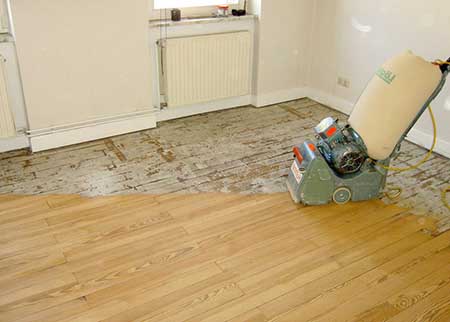
As already mentioned in the previous chapters, finishing works can start after approx 10 days from the time the floor was laid. A drum floor grinder with a dust extractor is used for sanding. A sheet of abrasive cloth 200X600 mm in size with beveled corners is placed on the drum of the grinding machine. The canvas is fastened in the drum with a serrated eccentric, rotated with a key. The cloth should be well stretched and fit snugly and evenly against the felt-lined drum.
Parquet and wooden floor (except for plank flooring, which have a factory-finished surface) first it is coarse grinding with a 10-20 cloth. The grinder should be run with the same feed speed, parallel to one of the walls or boards, so that the following strokes fit tightly to each other. The second grinding is performed with sandpaper, grain size 40— 60, and the third - granulation 120— 140. You can sand the rough parts of the floor near the walls and corners, using a regular or angle drill with a grinding wheel for abrasive cloth. The mosaic tile floor is sanded twice with medium and fine granulation of the canvas. In some cases, next to an evenly laid 1st class parquet floor (or imported staves) the floor can only be sanded twice, similar to mosaic tiles.
With smooth ones, well-edged skirting boards, sanding of the floor should be carried out before plating. However, with not very smooth slats, grinding should be performed after nailing the slats, in front of which the wedges are removed.
Skirting boards are nailed to the floor or boards. The plinths should be attached to the walls. The slats and plinths at the corners and joints along the walls are cut at an angle of 45 °. It is a good idea to use a miter box for this purpose, which guarantees the trimming at the same angle. This makes it easier to connect two plinths or slats with each other, both at an angle and along a straight line. The battens are nailed using a hammer and a hammer, which is used to drive the nail into the wood. The plinths are attached to the wall with screws.
