Wood cutting
When we start processing wood by hand, we first of all get acquainted with the drawing of the object, which we want to perform. Then we prepare the necessary tools and all materials, from which the item is to be made.
In the next stage of work, we draw individual components of the object on the material, taking into account the dimensions; at the same time, some excesses in the material to be processed should be provided for.
The outlines of individual elements are marked with lines with a millimeter scale, this is the so-called. tracing. Timber tracing is the starting point for the next steps, to which the elements or their parts will be subjected; belong to them: cutting, planing, sawing, chiselling, drilling holes, grinding etc..
The cutting
The wood can be sawn crosswise, along the grain or diagonally, at different angles. Carpentry saws are used to cut wood, which can be divided into two main groups: tensioned frame saws and untensioned saws.
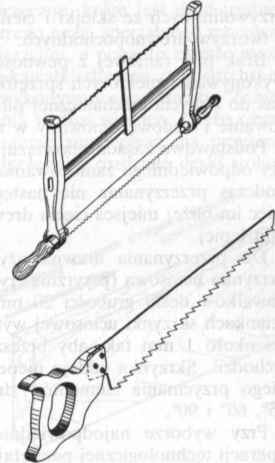
Depending on the method of cutting (sawing direction) and the type of wood, we use appropriate saws, which differ mainly in their dentition, yes in terms of shape, and size, and construction. Frame saw – although very useful in home DIY, unfortunately it is quite an expensive tool, moreover, very large compared to other tools i, worse, in relation to the place, which we most often have.
It is therefore a good idea to equip our workshop with an untensioned saw blade. However, when buying it, you should choose a saw with as little toothing as possible, because only such a method will enable precise cutting of small elements, without fraying or tearing the material off the cut edge, i.e. from the so-called. scratch.
In addition to the payer saw, we recommend purchasing a back saw (with a blade as stiff as possible) for cutting wood across the grain. A hole saw and a hair saw are also very useful, of course with the appropriate frame. The hair saw enables precise cutting of various curvilinear elements made of plywood and thinner boards, as well as from wood-based materials.
The lack of a frame saw will certainly be acute when making some equipment, but perhaps it will encourage us to buy a circular saw, the application and construction of which we will discuss in the next chapter.
The basic rule for sawing is that the workpiece is properly secured, that the wood does not vibrate when cutting. So the closer to the cut, the wood will be fixed, the better.
Do wood cutting one uses an apparatus called the miter box (they will cook).

It is made of three pieces of a board thick 20 mm. In the side, on the vertical walls of the miter box, make gaps approx 1 mm yes, that the saw blade fits freely into it. The box provides invaluable services when quickly cutting wooden elements at an angle of 30 °, 45°, 60° i 90°.
When choosing the most appropriate saw for the intended technological operation, remember, that small saws are best suited for cutting the wood across the grain, simple (triangular – isosceles) cloves, but for cutting along the grain – saws with large and sharply inclined teeth.
