Fireproof protections
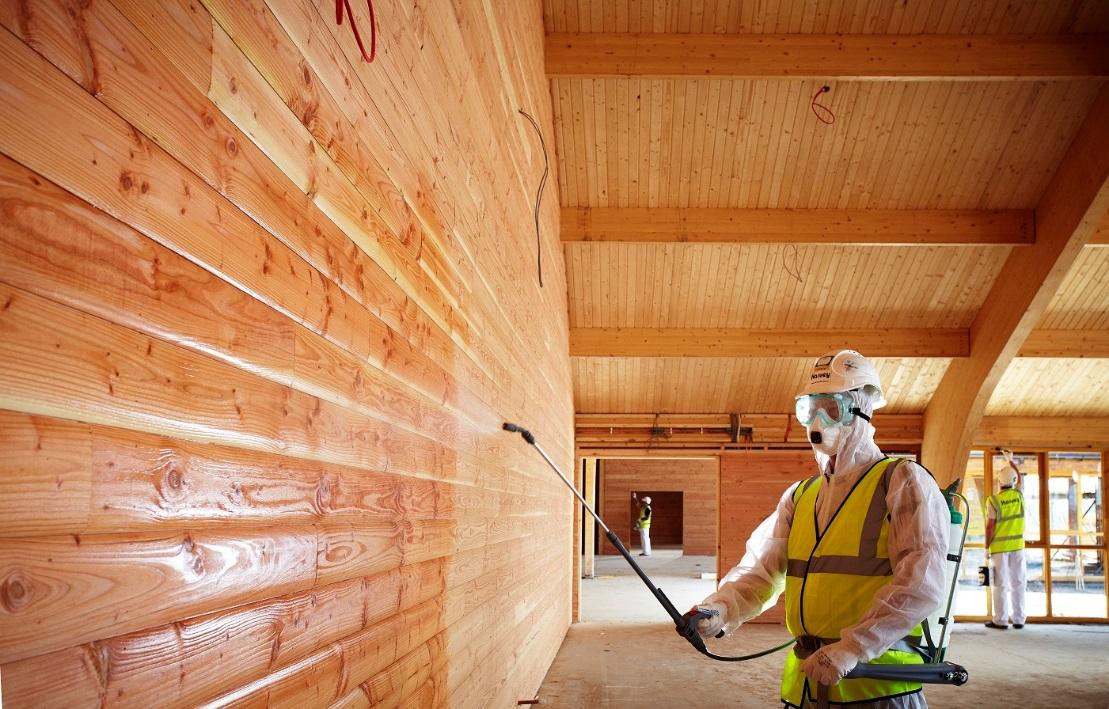 Fireproof protection of wooden structures
Wood it has been used as fuel for centuries. We all associate this material with the forest, campfire, flammability. Flammability is a very serious disadvantage of wood. We must be aware, that if we build wooden constructions we are obliged to secure the object against fire. Minimize its effects. Each object has a standard defined fire resistance class which it should fulfill. Persons on the premises should have sufficient time to leave it during a fire. The higher the ambient temperature and the drier the wood is, the easier it is to burn. The likelihood of a fire is then also greater. As a result of chemical changes, wood produces flammable gases at high temperatures. Self-ignition can take place at a temperature of approx 300 degrees Celsius, while ignition from a flame even at temperature 250 degrees Celsius.
We are obligated to cover wooden constructions flame retardants. There is a whole range of such preparations on the market. We are allowed to use agents approved for use in construction, that have the appropriate documents. They do not exist impregnaty, which completely protect the wood against the harmful effects of fire. There are funds available on the market, which hinder ignition and prevent further spread of the fire.
Wooden structure covered with a fire retardant preparation after securing it against biological corrosion. Means can be used, which at the same time protect the material against both fire and pests. There are different methods of applying fire protection to a structure. The preparation can be applied with a brush, by pressure methods, by showering or bathing.
Additionally, fire retardants are required, to:
- they were harmless to humans and animals,
- they did not emit toxic substances during normal operation and in fire conditions,
- did not change the color of the secured material,
- did not deteriorate the mechanical properties of the wood,
- retained their protective properties for at least three years.
Among the currently used fire retardants, we can distinguish the following three groups:
- Impregnaty.
- Emulsions.
- Varnishes and paints.
