Where in the walls should be installed anti-moisture insulation (diffusive)?
Where in the walls should be installed anti-moisture insulation (diffusive)?
On the general example of a double-sided wall boarded with double layers of boards with internal plaster on reeds, I will try to discuss the cases of arrangement of anti-damp insulation..
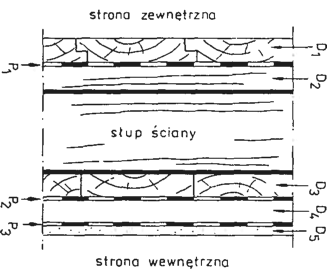 Where to install anti-moisture insulation in the wooden wall?
Dane:
D1 i D2 – outdoor boards
D3 and D4 – interior boards
T - internal plaster
P1 – built-in insulation between the external formwork D2 and Di
P2 – built-in insulation between the internal formwork D3 and D4
P3 – built-in insulation between D3 interior formwork and plaster
INSULATIONS ARE PLACED IN PLACES P1 and P2
If the construction timber and the thermal backfill between the layers of insulation are dry, and the insulation does not allow foreign moisture to enter the interior, then there is no fear of mold growth on the inside of the wall, it fulfills its task by protecting the walls from the cold. Occasionally a certain amount of moisture may settle between the P2 insulation and the D4 formwork, which will adversely affect the wood.
INSULATIONS ARE LOCATED IN PLACES P1 AND P3
If the wood and thermal insulation material are completely dry, then the stud wall behaves even better than under the analogous conditions in the previous example, because even the D4 formwork is protected against moisture. If, on the other hand, the wood and thermal insulation material between the layers of insulation is damp or wet, 1the whole structure is easily fungus.
INSULATION IS LOCATED IN PLACE P1
Moisture penetrating from the room settles on the cold surface of the insulation, which is the cause of the fungus in the wall.
THE INSULATION IS LOCATED IN PLACE P3
Good insulation protects the wall from moisture coming from the room.
External thermal insulation of the frame wall
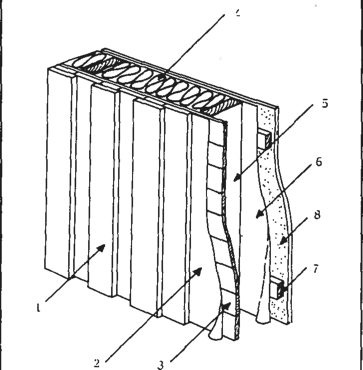 Signs:
1 -elevation made of thick boards. 22 mm
2 -perforated felt paper
3 – decking of the grub. 19 mm
4 – mineral wool 2 x 50 mm
5 – log poles 50 x 100 mm
6 – polyethylene foil vapor barrier
7 – patches 25 x 50 mm
8 – plasterboard thick. 12,5 mm
Materials needed for 1 m2 of wall thickness. total 20,5 cm
– balls of dimensions. 50 x 100 mm – 2,0 m
– boards not planed thick. 19 mm -1,0 m2
– one-sided planed boards, thickness. 10 mm -1,1 m2
– patches with dimensions 25 x 50 mm – 2,0 m
– 2 layers of mineral wool 2 x 50 mm -1,8 m2
– insulating tar paper -1,1 m2
– polyethylene film-1.1 m2
– plasterboard thick. 12,5 mm -1,0 m2
