Insulation of the house, part 3
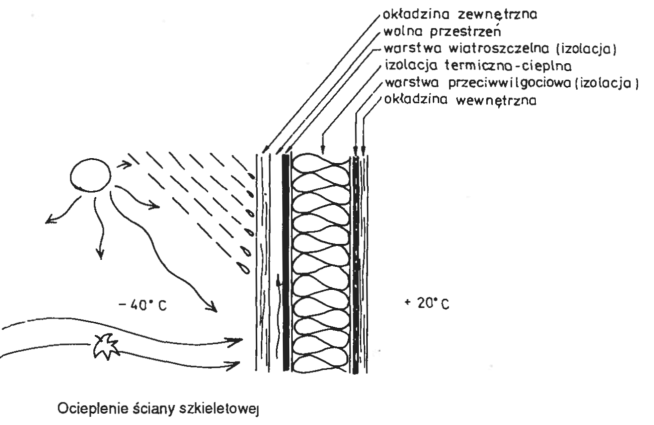 This is currently being done, using generally a polyethylene or polyvinyl film (PVC). It is important, that the foil has tight edges, and that any electrical lines that may be mounted are airtight. A straight wall now looks like this:
– internal decking (impregnated),
– diffusion layer (foil, asphalt roofing felt),
– thermal layer – mineral wool,
– external decking (impregnated).
Currently, impregnated chipboards are used as insulation layers in new homes. These plates prevent the movement of air in the mineral wool, as well as stiffen the walls. They are especially recommended in areas with strong winds, The roofing felt is easily torn when the decking is applied. In most cases, it is right and expedient to move the plates away from the back, to create better ventilation conditions. This is how the cladding – dries faster when wet with driving rain. The free space also equalizes the pressure, making water, which gets inside, is eliminated (drained). Stated, that the paint on the surfaces of these boards or boards lasts longer in such a situation. Factor, which is constantly quoted in connection with the described insulation, to tzw. heat transfer coefficient (K). This is the amount of heat in calories (heat units), which passes in one hour through 1 m2 of a given material with a difference between the outside and inside temperature of 1 ° C (1 K).
The measure of k in the old units was kcal /(m² · h · °C), and in the new SI units it is W /(m² • K),
where:
1 W/(m² • K) = 0,86 kcal/(m² · h · °C)
and vice versa
1 kcal/(m² · h · °C) = 1,163 W/(m² • K)
