Modern wooden structures
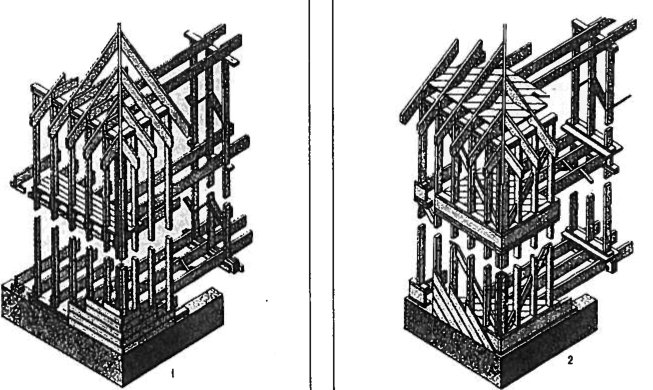 1.The type of wall structure with continuous columns - “Balloon frame”
2. Type of wall structure with interrupted columns at each story level – “Balloon western frame”
“Balloon frame” it is closely related to the level of industrialization achieved in America. Its invention practically transformed wooden construction from elaborate craftsmanship, performed by qualified builders, in industry.
The principle of the "balloon frame" is to replace by thin plates and posts – running along the entire height of the building and only nailed down – the existing old-fashioned and expensive construction method with tenon and keyway connections. Building a house like boxes, when using nails only, must have seemed revolutionary to carpenters and architects. Naturally, initially the "ballon frame" system met with opposition. The "balloon frame" has passed and lived through theoretical arguments, ridicule and insults of all, who thought, that she should be attacked… Its name was pronounced contemptuously by routine fitters, who have been taught to rob a piece of wood of all its strength and endurance by cutting many tenons in it, keyways and by drilling holes, assuming, that it will be stronger than a much thinner post, applied differently and not weakened by anything.
One man and one boy could go in 1865 years to achieve the same results with ease, like twenty men by an old-fashioned skeleton. The balloon frame principle is most appropriate for both potency, as well as for economy. When hiring a fitter, the cost of setting up this structure may be forty percent lower than the cost of the frame for a tenon and a groove. (mullion-transom structure).
No machine-produced nails “balloon frame” would be economic nonsense. It was only when the use of machines made, that nails have become cheaper, and wire nails were of excellent quality and much cheaper, than forged nails – the relatively expensive system of building the frame of the house by the method of joining with tenons and grooves began to give way to the more economical system, dependent solely on the efficiency of the nails.
